

Executive Summary
What is Teflon®?
Teflon is characterized by its water- and oil-repellent, non-stick properties, making it a common choice for cookware coatings. Its resistance to acids, alkalis, and various organic solvents allows for extensive use in the chemical industry as a stable material for handling corrosive chemicals. Furthermore, its low coefficient of friction makes Teflon an ideal lubricating interface for mating surfaces, helping to reduce wear and energy consumption.
Currently, Teflon is widely applied across the food, semiconductor, chemical, mechanical, construction, and medical industries. While specific properties and application focuses may vary by industry, it is universally regarded as a stable, safe, and highly durable premium material.
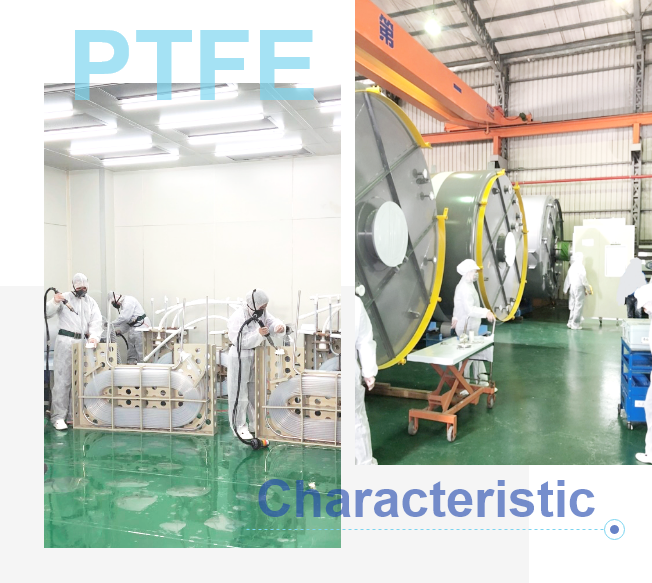
Key Properties of Teflon PTFE (Polytetrafluoroethylene)
- Excellent chemical resistance and anti-stick properties
- Wide operating temperature range (–200°C to +260°C)
- Extremely low coefficient of friction, ideal for lubrication purposes
- Superior electrical insulation
- UV resistant
- Excellent surface smoothness and durability
PVDF Material Properties and Application Advantages
PVDF, short for Polyvinylidene Difluoride, is a highly non-reactive thermoplastic fluoropolymer. It offers excellent chemical stability and processability, and is commonly used in pure water systems, membrane fabrication, and insulation for electronic components.
Compared to Teflon (PTFE), PVDF has a lower density and is ideal for producing pipes, substrates, cable jacketing, and other components requiring mechanical strength and corrosion resistance. It is widely applied in high-standard industries such as chemical processing, semiconductors, and pharmaceuticals.
Although both fluoropolymers are high-performance plastics, their application scenarios and molding methods differ. EVERSUPP Tech is deeply familiar with PVDF and PTFE processing conditions and can recommend the most suitable materials for high-specification manufacturing environments based on actual requirements.
Comparison Between NEW-PTFE and PFA
NEW-PTFE offers a smoother surface and superior cleaning performance compared to PFA
Smooth surface and easy to clean.
The wetted surface maintains high flatness; microscopic observation (10,000×) reveals low roughness, effectively reducing the risk of residue and contamination, making it ideal for high-purity processes.
NEW-PTFE Corrosion Resistance Testing
Accelerated corrosion tests using 98% concentrated nitric acid and continuous outdoor environmental testing for five years showed no abnormalities in NEW-PTFE sheets, demonstrating outstanding long-term chemical resistance.
Excellent Weld Strength
Unlike traditional lining sheets which are prone to weld cracking, NEW-PTFE linings remain structurally intact after peel testing, with no delamination or rupture. Its high ductility (maximum elongation up to 450%) effectively absorbs thermal stress and external deformation, enhancing reliability.
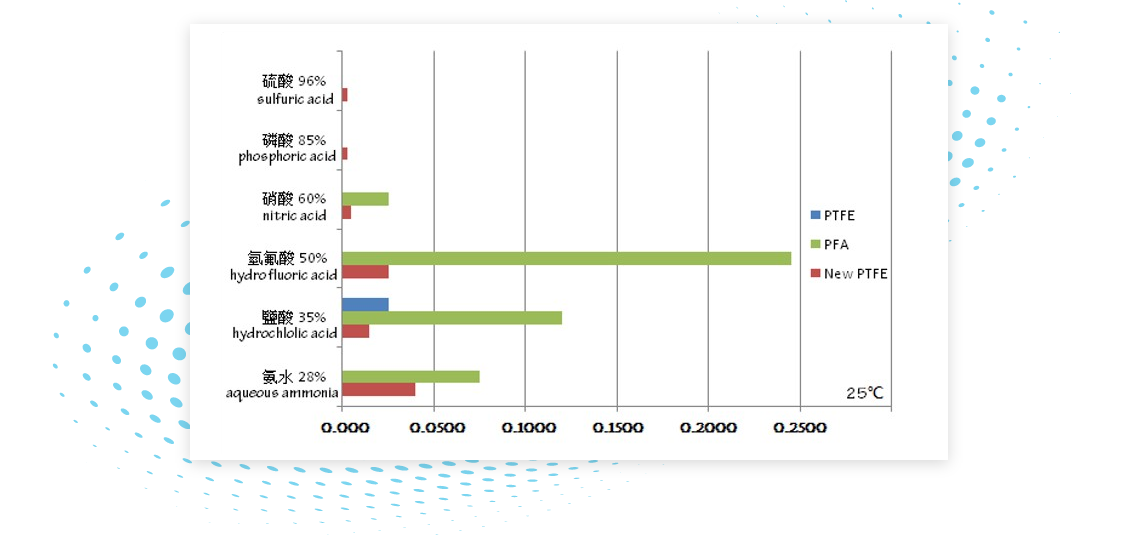
Chemical Permeation Resistance Comparison
In highly corrosive environments such as Hydrofluoric Acid, Hydrochloric Acid, and Ammonia, NEW-PTFE exhibits significantly better permeation resistance than PFA. This highlights the distinct PFA vs. PTFE differences, making it a reliable material choice for enhanced sealing and durability.
Permeation Resistance Comparison Table: HCl / HF / Ammonia
| Properties | Unit | ASTM Test Method | PTFE | FEP | PFA | ETFE | ECTFE | PVDF | TFM | ||
|---|---|---|---|---|---|---|---|---|---|---|---|
| Physical Properties | Melting Point | ℃ | - | 327 | 275 | 310 | 270 | 220-245 | 156-178 | 327 | |
| Specific Gravity | D792 | 2.14-2.20 | 2.12-2.20 | 2.12-2.17 | 1.70 | 1.68-1.69 | 1.75-1.78 | 2.16-2.19 | |||
| Mechanical Properties | Tensile Strength | kgf/cm² | D638 | 140-350 | 190-220 | 280-300 | 460 | 420 | 250-510 | 250-350 | |
| Elongation | % | D638 | 200-400 | 250-330 | 300 | 100-400 | 200-300 | 12-430 | 250-450 | ||
| Compressive Strength | kgf/cm² | D695 | 120 | 155 | - | 500 | - | 460-980 | 160 | ||
| Impact Strength (Izod) | kgfcm/cm | D256A | 16.3 | OK | OK | OK | OK | 16.3-38.1 | - | ||
| Rockwell Hardness | - | D785 | - | - | - | R50 | R93-95 | R77-83 | - | ||
| Shore Hardness | - | D2440 | D50-55 | D60-65 | D64 | D75 | D55 | D75-77 | D58 | ||
| Flexural Modulus | 103kgf/cm² | D790 | 5.6 | 5.6-6.7 | 8.4 | 14 | 6.7-7.0 | 20.4-25.3 | - | ||
| Tensile Modulus | 103kgf/cm² | D638 | 4.1-5.6 | 3.5 | - | 8.4 | 16.8 | 10.2-30 | - | ||
| Dynamic Friction Coefficient | - | 7kgf/cm² 3m/min |
0.10 | 0.3 | 0.2 | 0.4 | - | 0.39 | 0.18 | ||
| Electrical Properties | Volume Resistivity | Ω-cm | D257(50%RH.23℃) | >1018 | >1018 | >1018 | >106 | 1015 | 2×10¹⁴ | >1018 | |
| Dielectric Breakdown Strength (Short term) | kv/mm(3.2mm thick) | D149 | 19 | 20-24 | 20 | 16 | 20 | 16 | 19 | ||
| Dielectric Constant 60HZ | - | D150 | <2.1 | 2.1 | <2.1 | 2.6 | 2.6 | 2.6 | <2.1 | ||
| 103HZ | - | D150 | <2.1 | 2.1 | <2.1 | 2.6 | 2.6 | 2.6 | <2.1 | ||
| 106HZ | - | D150 | <2.1 | 2.1 | <2.1 | 2.6 | 2.6 | 2.6 | <2.1 | ||
| Dissipation Factor 60HZ | - | D150 | <0.0002 | <0.0002 | <0.0002 | <0.0006 | <0.0005 | <0.0006 | <0.0002 | ||
| 103HZ | - | D150 | <0.0002 | <0.0002 | <0.0002 | <0.0008 | <0.0015 | <0.0008 | <0.0002 | ||
| 106HZ | - | D150 | <0.0002 | <0.0005 | <0.0003 | <0.005 | <0.015 | <0.005 | <0.0002 | ||
| Arc Resistance | sec | D495 | >300 | >300 | >300 | 75 | 18 | 75 | >300 | ||
| Durability | Chemical Resistance | - | D543 | Excellent | Excellent | Excellent | Excellent | Good | Good | Excellent | |
| Flammability | - | D635 | Non-flammable | Non-flammable | Non-flammable | Non-flammable | Non-flammable | Self-extinguishing | Non-flammable | ||
|
Water Absorption 24H |
% | D570 | <0.01 | <0.01 | <0.03 | <0.029 | <0.01 | <0.04 | <0.01 | ||
| Thermal Properties | Thermal Conductivity | 10-4cal/cm²sec℃ | C117 | 6.0 | 6.0 | 6.0 | 5.7 | 3.8 | 2.4-3.1 | 6.0 | |
| Specific Heat | cal℃/g | - | 0.25 | 0.28 | 0.25 | 0.46-0.47 | - | 0.33 | 0.25 | ||
| Linear Expansion Coefficient | 10-4/C | D696 | 10 | 8.3-10.5 | 12 | 5.9 | 8 | 7-14 | 12 | ||
| Ball Pressure Temperature | ℃ | - | 180 | 170 | 230 | 185 | - | - | - | ||
| Heat Deflection Temperature | 18.5kgf/cm² | ℃ | D648 | 55 | 50 | 47 | 74 | 77 | 54-115 | - | |
| 4.6kgf/cm² | ℃ | D648 | 121 | 72 | 74 | 104 | 116 | 138 | - | ||
| Max. Continuous Service Temp. | ℃ | - | 260 | 204 | 260 | 150-180 | 165-180 | 150 | 260 | ||
EVERSUPP
EVERSUPP: Specialists in Comprehensive Teflon Process Applications
EVERSUPP Tech specializes in the process applications of Teflon (PTFE) and its derivative materials. Our service scope covers Teflon lining and coating, Teflon fabrics, heat exchangers, Teflon hoses, precision machining, and various customized products.
To ensure process transparency and quality consistency, EVERSUPP has pioneered the "Product Traceability" concept. From raw material sourcing and processing workflows to QC inspections and final client acceptance, we maintain fully traceable records to help mitigate risk and satisfy high-specification requirements.
Currently, EVERSUPP’s Teflon applications are widely integrated into semiconductor chemical storage tanks, acid supply systems, precision piping, corrosion-resistant vessels, and sealing components. Our stable quality has earned significant recognition from chemical and semiconductor industry clients worldwide.
For more information on Teflon process applications, please contact the EVERSUPP team.
Contact UsPractical Experience Q&A
Nov 10th - Inquiry from TSMC Factory Audit:
-
Q1 Why is 3mmT Teflon lining used for the interior of the tanks?In the past, 2mmT thickness was the standard for sheet lining. Considering the chemical permeation rate, thicker sheets provide better resistance. Therefore, 3mmT has become the current global industry standard for optimal protection.
-
Q2 Why not use 5mmT Teflon lining for the tank interior?5mmT sheets are significantly stiffer. During the bending and fitting process, they are prone to wrinkling or trapping air bubbles, which compromises the bonding quality and sealing integrity. Consequently, 3mmT remains the mainstream specification in practical application.
Oct 17th - Consultation from China Ecotek (CEC) Factory Audit:
-
Q1 Is there any benefit to adding fiberglass backing to the Teflon sheets to improve adhesion to the tank interior?Fiberglass backing provides excellent adhesion specifically for high-temperature zones. However, under standard operating conditions, peel tests show no significant difference in the adhesion performance of the Teflon sheets themselves.