

A PTFE lining creates a chemically resistant wetted layer inside a chemical storage tank, separating acids, alkalis and process chemicals from the tank substrate. This helps reduce corrosion, metal-ion leaching and deterioration of the wetted surface. Even with the same lining material and chemical service, service life can vary considerably. The difference often lies not in the material itself, but in the installation and design details.
Key Takeaways
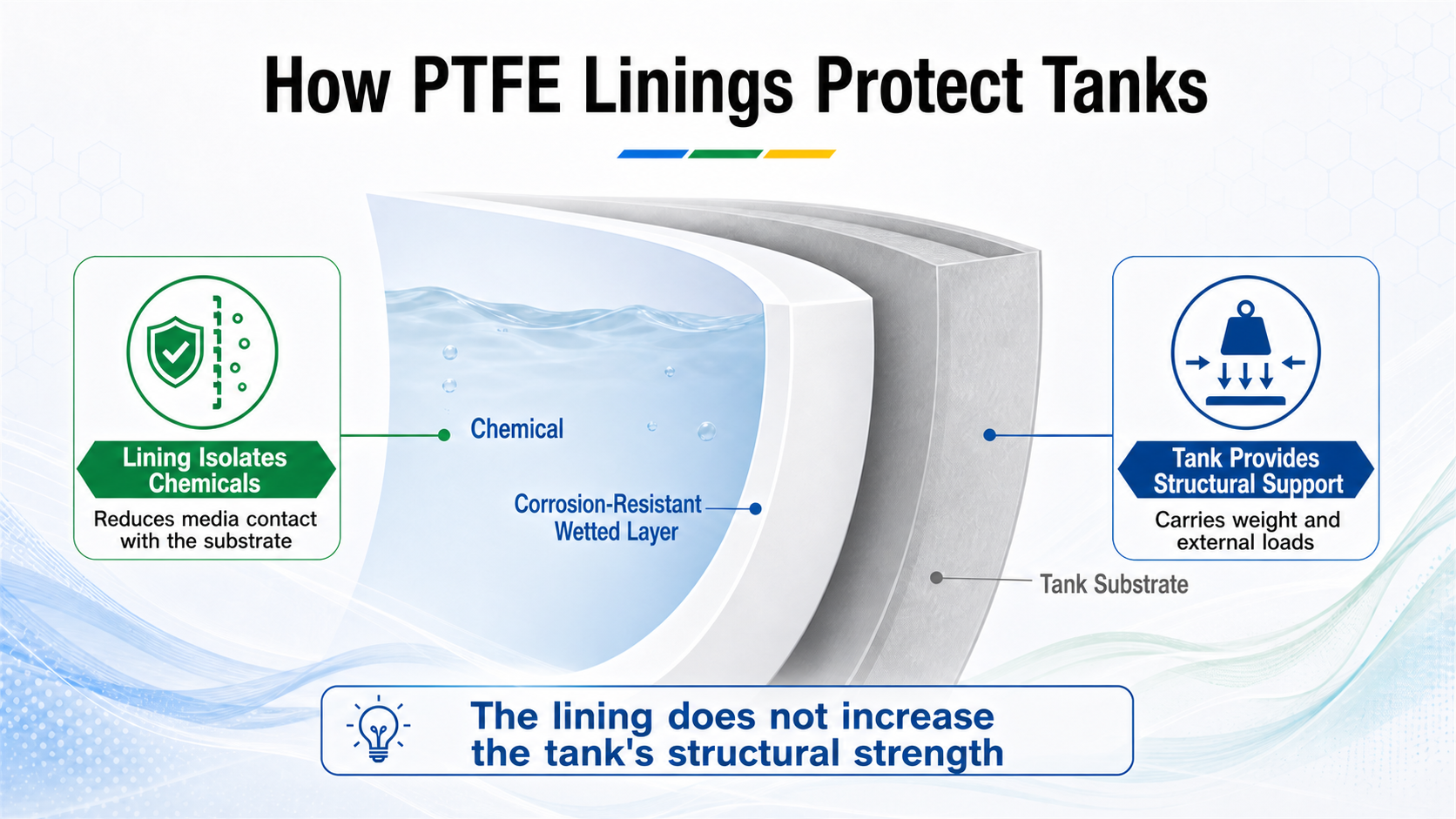
- The lining isolates the chemical from the tank; it does not increase the structural strength of the tank itself.
- Lining failures rarely begin at the center of a tank wall. They more often start at nozzles, flanges, corners and tank bottoms, where stress and retained liquid are concentrated.
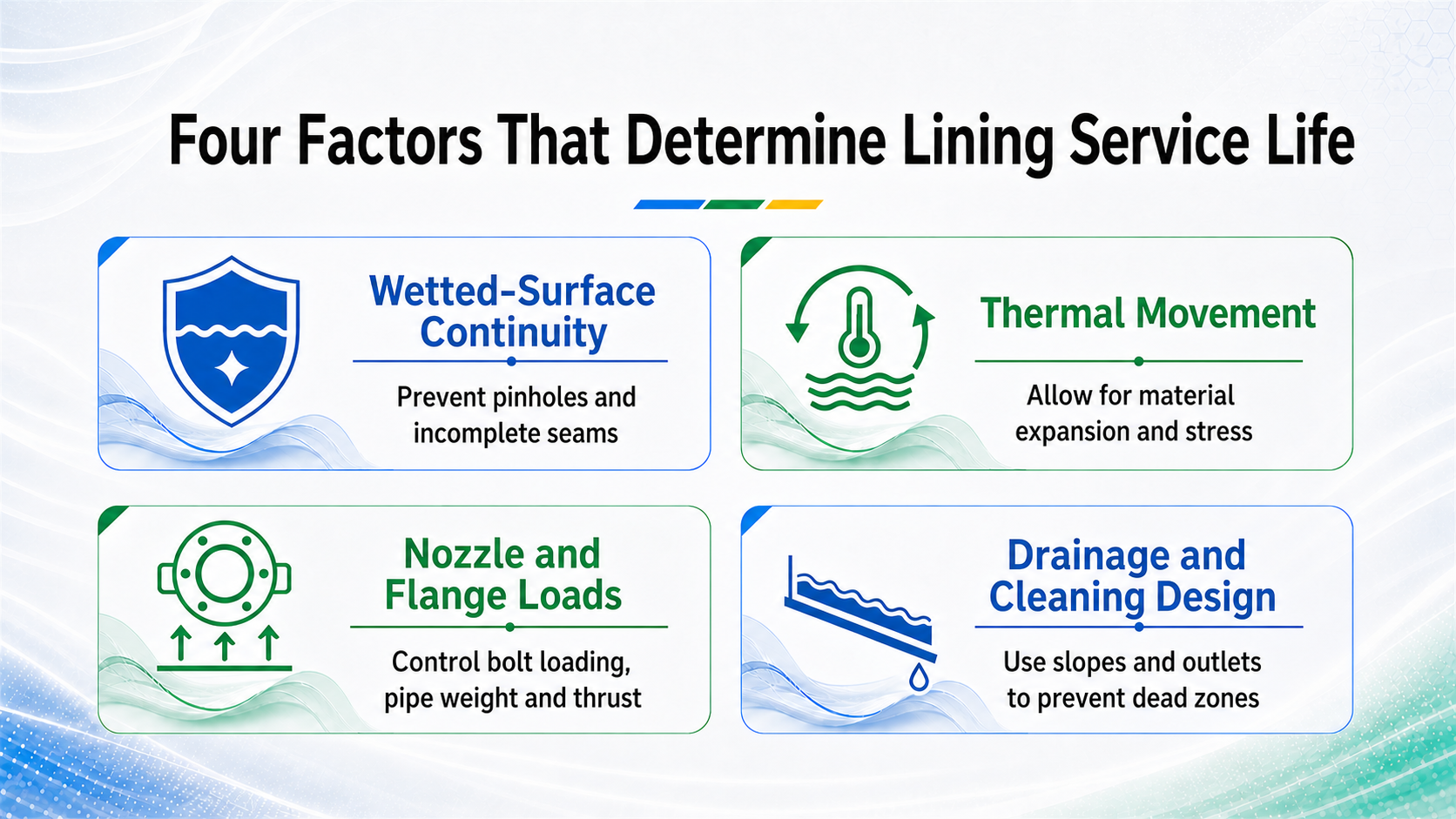
- Wetted-surface continuity, thermal-movement accommodation, nozzle loading and drainage design are four key factors affecting lining service life.
- If the substrate and primary structure of an existing tank remain serviceable, removal of the old lining, repair of the tank and installation of a new lining may be evaluated.
Contents
1. Why Do Chemical Storage Tanks Need PTFE Linings?
When carbon-steel, stainless-steel or composite storage tanks are exposed to corrosive chemicals, corrosion, leakage or surface deterioration may gradually develop at tank walls, welds, openings and nozzles. A metal tank may provide sufficient structural strength, but that does not mean it can remain in direct contact with every acid, alkali, solvent or high-purity chemical over the long term.
A PTFE tank lining covers the tank’s wetted surfaces and forms a continuous corrosion-resistant barrier. The metal tank carries the weight and external loads, while the lining isolates the chemical. This allows large tanks to retain the structural support provided by the metal substrate.
Corrosion rarely starts across a broad area at the center of the tank wall. It more often begins at geometric transitions or material interfaces, including the tank bottom, corners, nozzles, manholes, welds and flanges. These locations are therefore recurring priorities throughout the sections below.
2. How Do PTFE Linings Extend Chemical Tank Service Life?
The principle is straightforward: prevent the tank substrate from contacting the chemical directly. When the wetted layer remains intact, it can reduce acid and alkali attack, localized corrosion and metal-ion leaching, helping the tank’s primary structure remain serviceable.
The challenge is maintaining that continuity. If welds contain pinholes, nozzle terminations are incomplete or the lining delaminates locally, chemicals can migrate behind the lining and corrode the substrate where the damage cannot be seen from inside the tank. By the time bulging or leakage becomes visible, concealed corrosion may already have progressed. The causes of lining bulging and their relationship to venting design are discussed in greater detail in our material-selection guide.
For tanks that require regular cleaning or chemical changeover, PTFE’s low surface adhesion supports drainage and cleaning. However, retained liquid at the tank bottom must still be addressed through drainage slope, nozzle position and cleaning procedures; the material alone cannot resolve poor drainage.
Further ReadingEversupp Guide to Selecting Semiconductor-Grade PTFE Linings
3. Four Factors That Determine Lining Service Life
Wetted-Surface Continuity
A single discontinuity can allow chemicals to reach the back of the lining. Problems most often occur not across broad tank-wall areas, but at tank-bottom corners, nozzle terminations and manhole perimeters that require cutting, flanging and fusion welding. These locations are the most difficult to fabricate and among the hardest to inspect after completion.
Thermal-Movement Accommodation
Metal and PTFE have different coefficients of thermal expansion, so they expand and contract by different amounts during temperature changes. If the fastening method does not allow sufficient movement, stress can accumulate at corners and nozzles, eventually causing pulling, delamination or weld cracking. The more frequently a tank undergoes thermal cycling, the more important it is to plan sheet layout and movement allowance in advance.
Nozzle and Flange Loads
After the lining is flanged at a nozzle, it is secured by the mating flange. Uneven bolt loading, unsupported pipe weight or thermal movement that pushes or pulls the piping can strain the lining at the flange face. This is why failures often begin near nozzles rather than at the center of the tank wall. Piping support design is therefore part of lining service-life planning.
Drainage and Cleaning Design
If the tank bottom lacks sufficient slope, or the drain is not located at the lowest point, chemicals can remain in dead zones for extended periods. The same chemical can affect a lining differently under brief contact and continuous immersion, and residues may react with a new chemical during changeover.
4. Which Chemical Storage Tanks Are Suitable for PTFE Linings?
PTFE linings may be evaluated for equipment that stores corrosive chemicals, requires control of metallic contamination or needs to retain the strength of an existing tank. Material and installation methods must be selected according to the operating conditions:
| Tank Condition | Primary Purpose of the Lining | Evaluation Priorities |
|---|---|---|
| Strong-acid, strong-alkali or corrosive-solvent tanks | Isolate the chemical from the tank substrate | Chemical, concentration, temperature and long-term permeation |
| Electronic-grade or high-purity chemical tanks | Reduce metallic contamination and wetted-surface residue | Material purity, welds, cleaning and packaging |
| Heated, cooled or thermally cycled tanks | Protect the tank while accommodating repeated thermal movement | Differential expansion, seams, nozzles and fastening method |
| Reaction, mixing or recovery tanks | Provide a continuous corrosion-resistant wetted surface | Agitation loads, drainage dead zones and internal components |
| Existing tank refurbishment | Retain a serviceable substrate while renewing the wetted layer | Tank-wall corrosion, deformation, weld condition and openings |
If a tank has perforation, significant deformation, damaged supports or inadequate primary structure, relining cannot replace structural repair. The substrate and structure should first be confirmed as suitable for continued service before deciding on localized repair, complete relining or tank replacement.
5. Installation and Maintenance Details to Consider
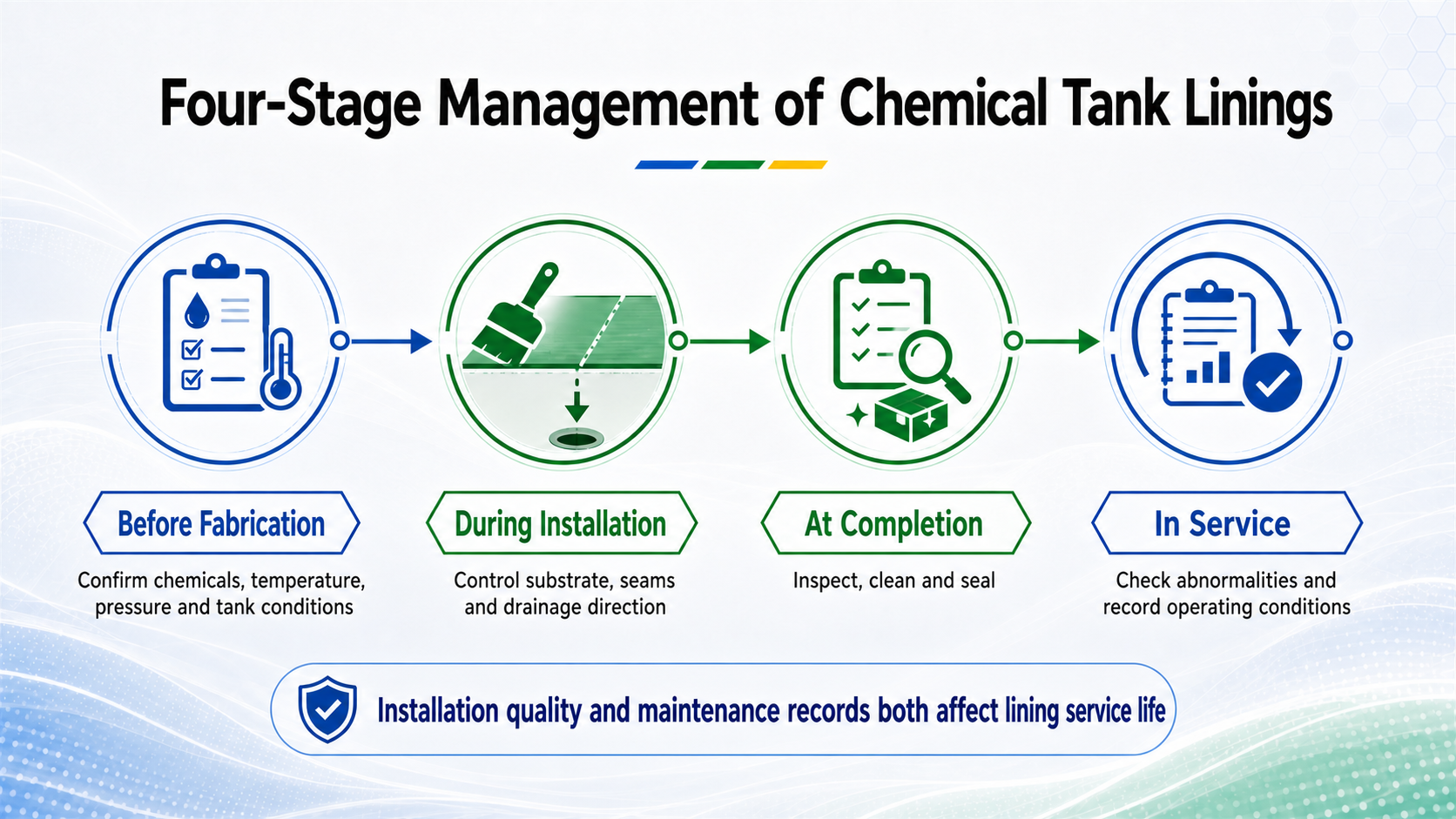
Many aspects of PTFE lining quality cannot be corrected after installation is complete. Each of the following four stages therefore includes work that must be controlled at the time it is performed.
Before Fabrication: Confirm the Operating Conditions
- Chemical and concentration; normal and maximum temperature; operating pressure or vacuum.
- Tank dimensions; nozzle and manhole locations; agitator arrangement; drainage and cleaning methods.
- These conditions directly determine sheet thickness, sheet layout and fastening method. The design cannot be finalized if any essential condition is missing.
During Installation: Substrate and Seams
- Treat corrosion, oil contamination, sharp corners, uneven surfaces and incomplete welds before installing the lining sheets.
- Plan sheet layout, corners and seams according to tank dimensions and thermal expansion, keeping seams away from high-stress areas.
- At nozzles and flanges, prevent the lining from being strained by bolt loading, thermal movement or piping loads.
- Confirm the drainage direction at the tank bottom so chemicals do not remain in dead zones.
At Completion: Inspection and Sealing
- Arrange visual, dimensional, weld, pinhole, leak or pressure inspection according to the equipment’s intended service.
- Remove installation residue and seal openings to prevent secondary contamination during transport and installation.
In Service: Inspect and Record Regularly
- Check for discoloration, cracks, bulging, delamination, leakage and abnormal conditions around flanges.
- Record the location of each abnormality and the operating conditions at the time.
- Repeated abnormalities at the same location usually indicate a design or load issue rather than simple material wear.
6. Eversupp Chemical Tank Lining and Equipment Services
Eversupp provides fluoropolymer lining services for tanks and vessels, ISO TANKs, filtration equipment, heat exchangers, lined fittings and custom products. PTFE, M-PTFE and PFA configurations can be reviewed according to the chemical, concentration, temperature and pressure, tank dimensions and site conditions.
- New Tanks: Work begins with a review of operating conditions and drawings, followed by material confirmation, fabrication, on-site work, quality control and completion inspection.
- Existing Tanks: Tank walls, welds, supports, openings and the existing lining are inspected before localized repair, complete removal and relining, or piping and valve replacement is evaluated. A new lining is not applied over unresolved substrate defects.
- Delivery Records: Material, fabrication and inspection information is retained in product traceability records for delivery and subsequent review.
Eversupp has more than 20 years of PFA fabrication experience and has served over 300 customers. Its ISO TANK and fluoropolymer-lined products also have experience with recognized inspections by China Classification Society (CCS), Bureau Veritas (BV) and Lloyd’s Register (LR).
7. Frequently Asked Questions
-
Q1 Can a tank remain in service after the lining is scratched?This depends on whether the scratch penetrates the wetted layer and whether nearby cracking, bulging, discoloration or leakage is present. If the substrate is exposed, or chemicals may have reached the back of the lining, the equipment should be taken out of service and inspected in accordance with site safety procedures before localized repair or broader replacement is considered. Surface scratches and through-thickness damage require different responses.
-
Q2 Why do lining failures often begin near nozzles and flanges?These areas are exposed to three loads at once: flange-bolting pressure, piping weight and the push-pull forces produced by thermal movement. The center of a tank wall is exposed mainly to static chemical contact, while nozzles concentrate stress and require flanging, cutting and fusion welding of the lining. They are therefore among the most vulnerable parts of the tank.
-
Q3 Can retained liquid at the tank bottom shorten lining service life?Yes, and the effect is often underestimated. Short-term contact and continuous immersion in the same chemical can affect the lining differently. Retained-liquid zones also collect residue and may become sites of cross-reaction during chemical changeover. Inadequate drainage slope or a drain located above the lowest point cannot be corrected by cleaning alone.
-
Q4 Should the tank be taken out of service immediately if the lining bulges?Bulging indicates that chemical or gas has reached the back of the lining. It is a signal for prompt inspection, not merely a cosmetic issue. The affected area and substrate condition should be assessed in accordance with equipment safety procedures before the next action is determined. Continued use under the original operating conditions is not recommended.
-
Q5 How long does a PTFE lining typically last?Service life is often determined not by the material itself, but by the first location to fail—such as a nozzle, flange, corner or tank bottom. With the same material and chemical service, differences in installation quality and drainage design can produce very different service lives. It is therefore more useful to confirm how these critical locations were designed and fabricated than to assign a single number of years to the material.