

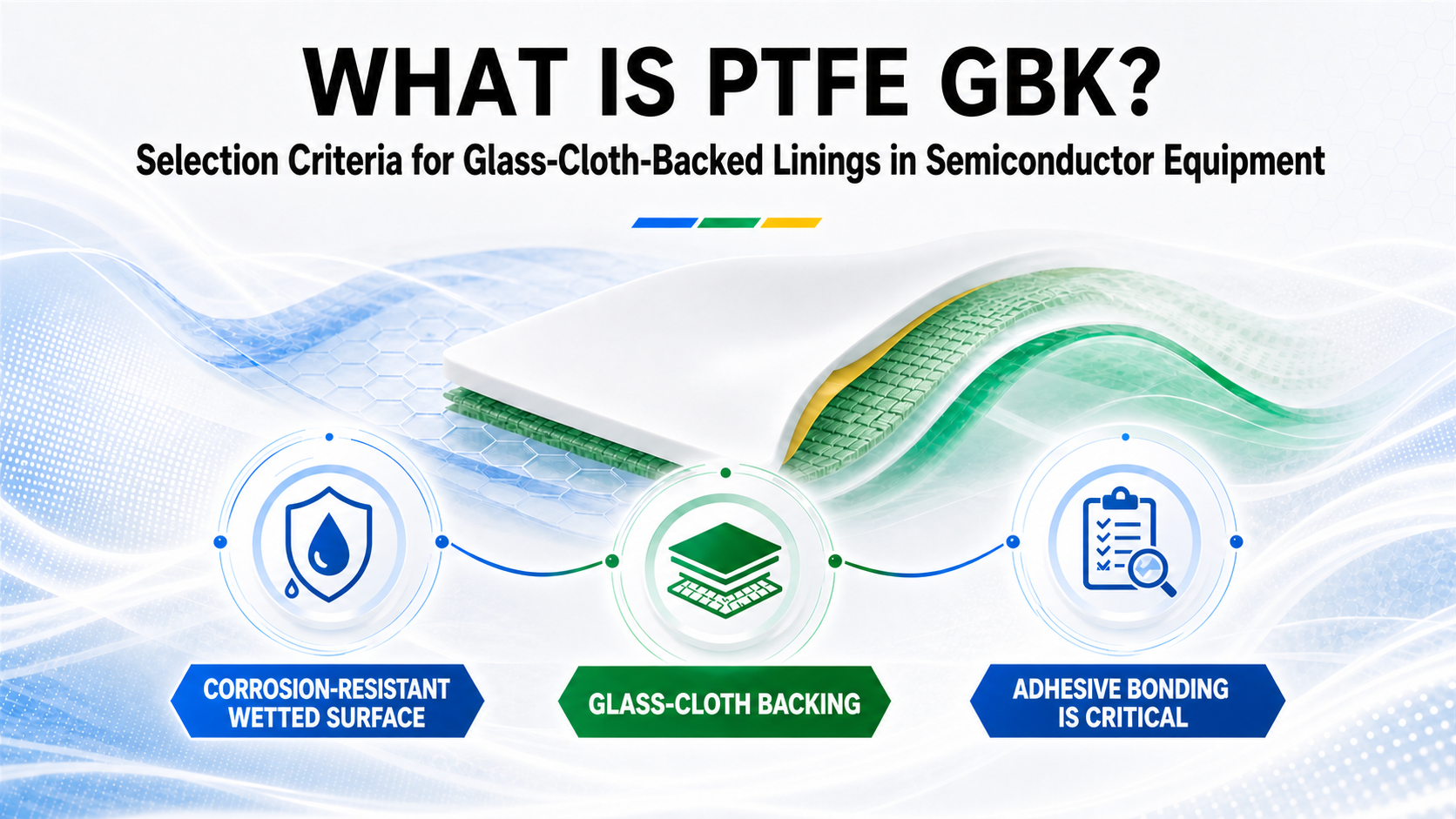
The PTFE GBK liner is a composite liner structure in which glass fiber fabric is bonded to the back of a PTFE sheet, and the sheet is then fixed to the equipment substrate. The wetted side retains the chemical resistance of PTFE, while the backing side provides an adhesive interface, making it suitable for semiconductor chemical equipment where corrosion resistance and cleanliness are critical.
This article focuses on:
- GBK is a glass cloth backing, not simply glass fiber mixed into a PTFE wetted layer—the two have different structures and applications.
- The upper temperature limit of a GBK lining is usually determined by the adhesive, and cannot be directly applied using the temperature resistance figures of the PTFE raw material.
- Tanks and containers are the main applications of GBK; heat exchange equipment mainly uses it for the shell and wetted areas, with PFA tube bundles used for the heat exchange surface.
- The effectiveness of the lining depends on the substrate treatment, adhesion, seam welding, and inspection; these cannot be remedied after completion.
Table of Contents
1. What Is PTFE GBK? Understanding the Glass-Cloth Backing Structure
PTFE glass-cloth backing (PTFE GBK) is a composite lining sheet composed of a PTFE wetted layer and a glass-cloth backing layer. PTFE surfaces are not easily directly bonded; after bonding the back with plain-woven glass cloth, the adhesive can adhere to the backing, allowing the sheet to be fixed to the steel tank or equipment substrate.
The glass cloth is located on the back of the sheet and does not directly contact the chemical liquid. PTFE GBK is not glass-fiber-filled PTFE; filled PTFE incorporates filler into the material itself, while GBK adds an adhesive backing to the lining sheet.
| Comparison Items | Unbacked PTFE Sheets | PTFE GBK Sheets |
|---|---|---|
| Structure | PTFE Sheet Body | PTFE Sheet Backing with Glass Cloth |
| Fixing Methods | Mechanical fixing or other installation methods depending on equipment structure | Can be fixed to equipment substrate using adhesive systems |
| Common Considerations | Fixing methods, thermal expansion and contraction, and seam configuration | Backing quality, adhesive, substrate treatment, and seam welding |
| Applicable Directions | Parts, liners, or specific equipment structures | Tanks, containers, and chemical equipment requiring adhesive linings |
The fixing methods for unbacked sheets, etched backing sheets, glass cloth backing sheets, and molded liners differ; installation and acceptance standards cannot be mixed.
2. Why Does Semiconductor Equipment Require PTFE GBK?
Semiconductor wet processing and chemical supply systems come into contact with acids, alkalis, and process solutions. The metal tank provides the necessary strength, while the PTFE liner isolates the chemical solution, reducing the risk of tank corrosion and metal ion leaching.
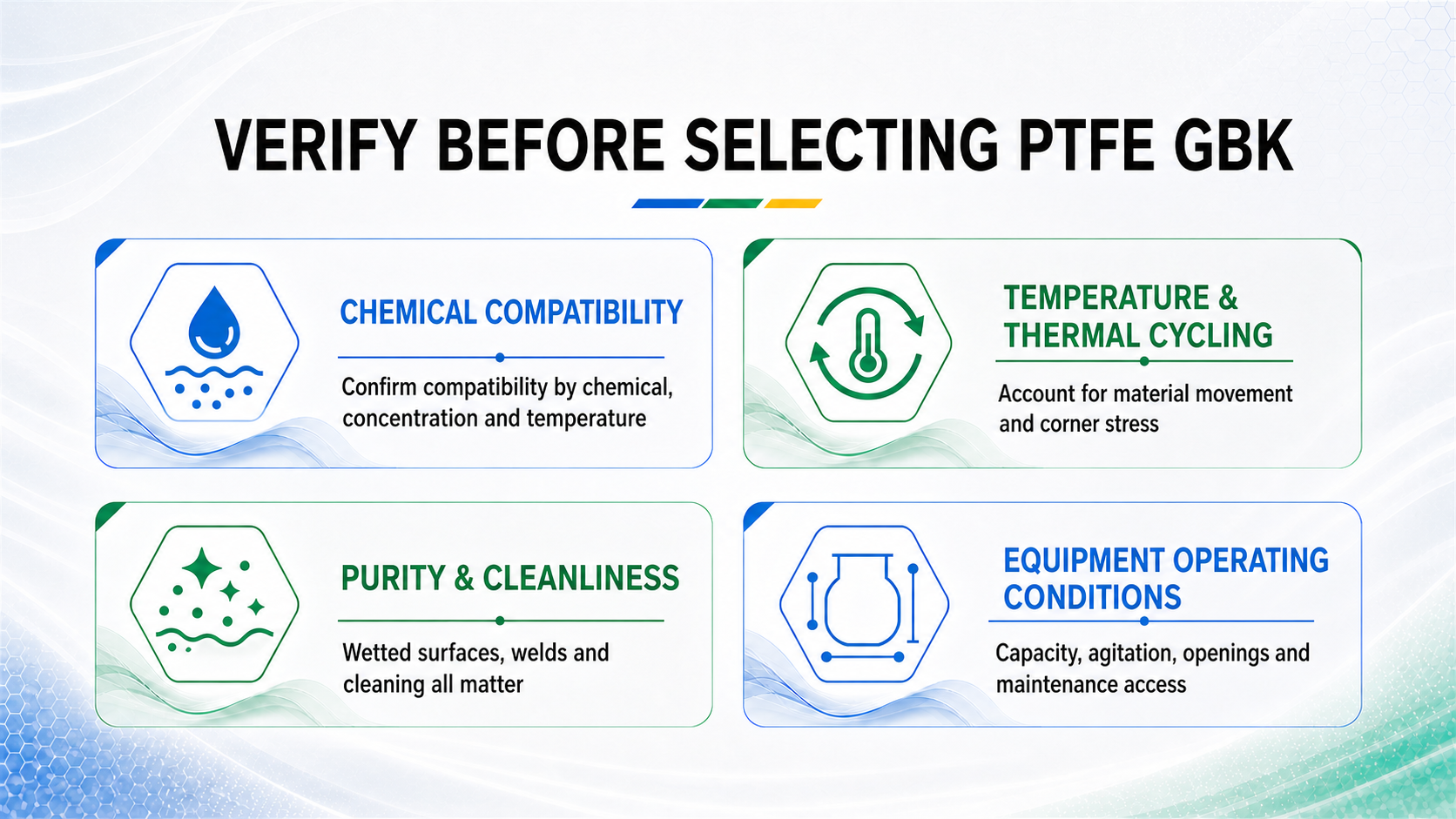
Four main conditions must be considered when selecting PTFE GBK:
- Highly Corrosive Chemicals: The concentration and temperature of acids, alkalis, or solvents can alter the penetration risk; compatibility must be confirmed based on the actual medium.
- Temperature and Thermal Cycling: Temperature fluctuations cause varying degrees of expansion and contraction in the metal, adhesive layer, and PTFE. Stress treatment is required at corners, nozzles, and welds.
- Purity and Cleanliness Requirements: Contact surfaces, weld beads, cleaning, and encapsulation can all affect particulate matter or residue.
- Equipment Operating Environment: Tank capacity, agitation, pressure, maintenance space, and opening configuration will affect sheet thickness and mounting methods.
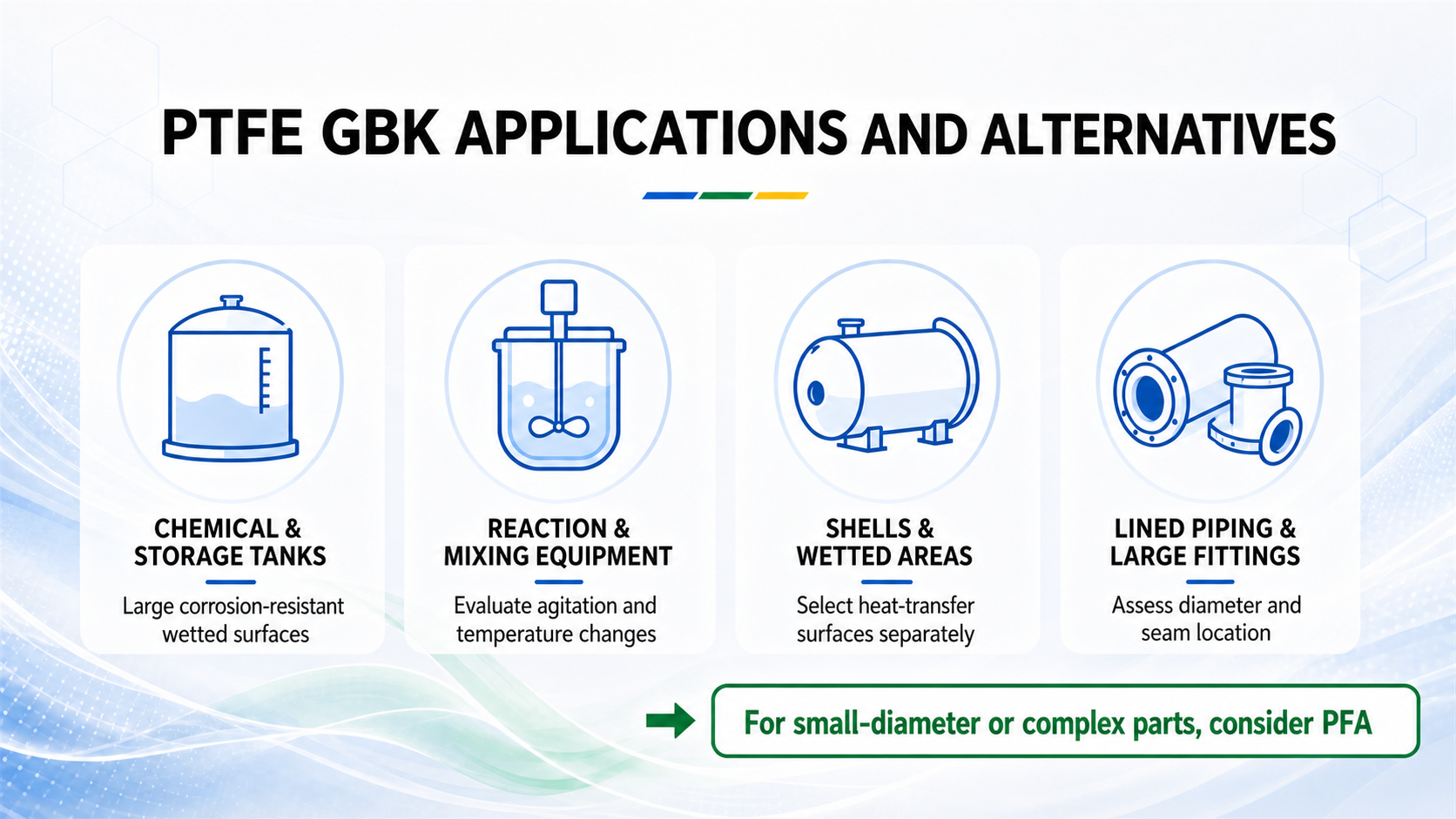
If GBK sheets are difficult to fit or inspect, small-diameter pipes and complex parts can be replaced with PFA pipes, molded parts, or other weldable fluoropolymer products.
3. Four Key Advantages of PTFE GBK
Corrosion Resistance
The PTFE lining isolates the chemical from the steel tank, reducing the risk of tank corrosion and metallic contamination.
Temperature Resistance
PTFE itself can be used across a broad temperature range, but the actual upper temperature limit of a GBK lining is usually governed by the adhesive. The adhesive layer generally has a lower temperature limit than the PTFE resin. If the adhesive system’s allowable range is exceeded, failure can begin at the bonding interface even while the wetted surface still appears intact.
Structural Stability
The glass-cloth backing provides a bondable interface, enabling the PTFE sheet to adhere across the equipment substrate instead of relying only on localized fastening points. Proper control of substrate preparation, adhesive thickness and seam placement helps reduce localized movement or bulging.
High Cleanliness
The wetted side is a continuous PTFE surface, so neither the metal substrate nor the glass cloth contacts the chemical. PTFE’s low surface adhesion also supports cleaning and residue control.
Further ReadingWant to compare the properties of PTFE, M-PTFE and PFA in more detail? SeeEversupp’s Guide to Fluoropolymer Materials
4. Which Semiconductor Equipment Is Suitable for PTFE GBK?
PTFE GBK is suitable for equipment with an installable substrate, a large corrosion-resistant wetted area, and sufficient access for seam placement and inspection. Typical applications include:
- Chemical and Storage Tanks: Used to store feed chemicals, recovered solutions or process chemicals. The tank bottom, corners, nozzles and manholes require a continuous lining.
- Reaction Vessels and Mixing Equipment: In addition to chemical compatibility, agitation loads, temperature changes and internal components must be evaluated.
- Filtration and Heat-Exchange Equipment: Linings protect shells and wetted areas from corrosion. Heat-transfer surfaces typically use PFA tube bundles, while filter elements, seals and flanges require separate material selection.
- Lined Piping and Large Fittings: Suitability depends on diameter, elbows, vacuum conditions, installation access and seam location.
- Custom Chemical Equipment: Sheet layout and welding sequence can be planned from drawings for collection tanks, overflow tanks and equipment with special openings.
5. Key Points for the Design, Installation, and Acceptance of PTFE GBK Linings
Before fabrication, confirm the medium, concentration, temperature, pressure or vacuum, tank dimensions, openings, and cleaning method. Then determine the sheet thickness, glass cloth type, adhesive system, and weld locations.
Construction and acceptance can be carried out in the following order:
- Inspect the Substrate: Treat rust, oil stains, sharp corners, and protrusions that may puncture the lining.
- Arrange the Plates and Joints: Cut according to the tank dimensions and thermal expansion and contraction, avoiding high-stress or difficult-to-inspect locations.
- Control Adhesion and Welding: Confirm the adhesive application and curing conditions, as well as the welding rod and welding parameters.
- Perform Testing: Conduct visual, dimensional, joint, pinhole, pressure, or leak inspections according to the equipment's intended use.
- Cleaning and Sealing Completed: Remove installation residue and seal openings to prevent contamination or damage during transportation and installation.
For equipment with thermal cycling, check for bulging or delamination of the lining; for negative pressure equipment, confirm the stability of the fit; for mixing tanks and frequently cleaned equipment, strengthen the inspection of corners, pipes, and welds.
6. Eversupp Fluoropolymer Lining and Equipment Services
Eversupp provides fluoropolymer lining services for tanks and vessels, ISO TANKs, filtration equipment, heat exchangers, lined fittings and custom products. PTFE, M-PTFE and PFA configurations can be evaluated according to the chemical, equipment structure, dimensions, temperature and pressure.
Tank-lining projects can begin with a review of drawings and operating conditions, followed by material confirmation, fabrication, quality control and acceptance. Depending on project requirements, finished products may undergo visual, dimensional, pinhole or pressure inspection. Material, fabrication and quality-control information is retained in product traceability records.
For projects involving multiple pieces of equipment, lined tanks, fittings, valves, filters, heat exchangers and PFA chemical-supply systems can be reviewed as one fluid path to confirm connections, sealing and wetted materials.
These capabilities draw on more than 20 years of fluoropolymer fabrication experience and projects for over 300 semiconductor and chemical-industry customers. Eversupp’s products also have experience with recognized inspections by China Classification Society (CCS), Bureau Veritas (BV) and Lloyd’s Register (LR).
7. Frequently Asked Questions
-
Q1 Is PTFE GBK the same as glass-fiber-filled PTFE?No. PTFE GBK has glass cloth bonded to the back of the sheet, whereas glass-fiber-filled PTFE incorporates filler into the PTFE body. Their structures, wetted surfaces and applications are different.
-
Q2 Can PTFE GBK be applied directly to a rusted tank?This is not recommended. Rust, oil, weld slag and sharp protrusions can compromise adhesion and damage the lining. Welds should be dressed and the substrate surface properly prepared before installation.
-
Q3 Is PTFE GBK always more durable than a conventional PTFE lining?No. It is a different fastening method, not simply a more durable version. GBK uses adhesive to bond the sheet across the substrate for full-surface support, but the adhesive layer introduces temperature and interface limitations. Suitability depends on whether the equipment requires full bonding or mechanical fastening.
-
Q4 Must the old lining be completely removed before relining an existing tank with GBK?Yes. The new adhesive layer must bond to a clean metal substrate. Residual lining or adhesive creates an inconsistent bonding surface. Removal also reveals the substrate’s actual corrosion and deformation, which directly affect whether relining can proceed.
-
Q5 How can adhesion quality be verified after a GBK lining is installed?Visual, pinhole and seam inspections show the condition of the wetted surface, and voids or localized bulging may also become apparent. However, the adhesive layer is beneath the sheet and cannot be remedied after installation. Substrate preparation, adhesive application and curing control during installation are therefore decisive, making installation records especially important.