

In addition to equipment corrosion, advanced manufacturing processes also require attention to chemical penetration, particulate contamination, and connection leakage. When making improvements, the medium and operating conditions should be identified first, followed by a step-by-step investigation of materials, structure, processing, cleaning, and testing.
This article focuses on:
- Corrosion, contamination, and leaks can originate from different causes. Before making a judgment, the medium, concentration, temperature, pressure, and location of the anomaly must be recorded.
- PFA, PTFE, and M-PTFE have different processing methods. Material selection must be tailored to the medium, temperature, pressure, equipment structure, and testing conditions.
- Wetted surfaces, welds, flanges, and interfaces with dissimilar materials can all affect purity and sealing. These must be checked along with the equipment itself.
- Material certificates, process records, and finished product testing should be cross-checked to maintain traceable delivery documentation.
Table of Contents
I. What are the common corrosion and purity risks in advanced manufacturing processes?
Even if severe corrosion is not visible on the surface, advanced manufacturing equipment may already exhibit penetration, residue, or connection deterioration. Equipment inspection should cover the tank body, lining, welds, interfaces, and contact surfaces.
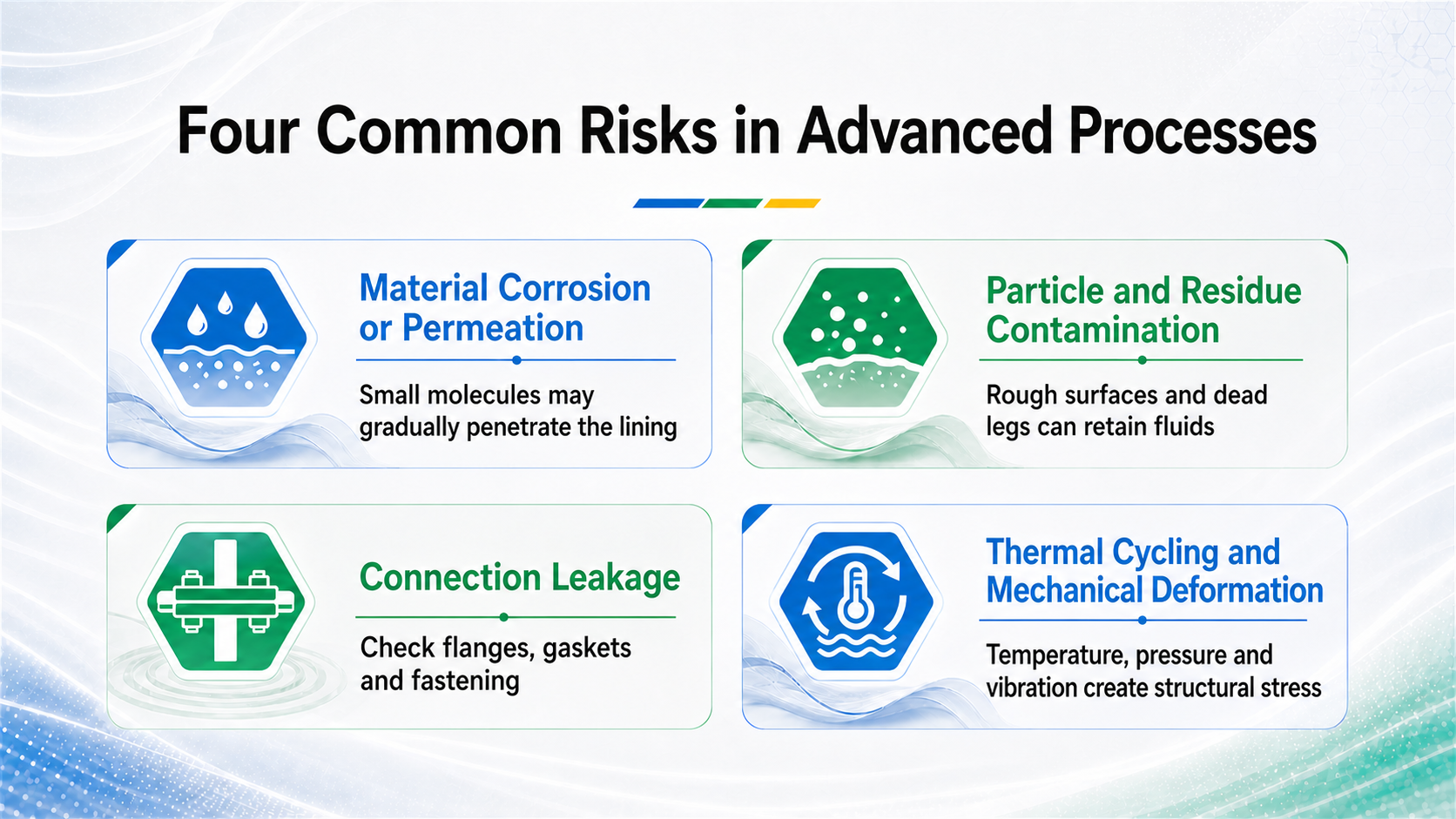
Common risks can be categorized into four types:
- Material Corrosion or PermeationSmall molecules may gradually penetrate the lining, affecting the backplate or metal tank body.
- Particulate and Residual ContaminationRough surfaces, weld protrusions, and drainage dead zones can easily trap chemical or cleaning solutions.
- Connection LeakageFlange misalignment, improper gasket fit, uneven tightening, or pipe pulling can all alter the sealing condition.
- Thermal Cycling and Mechanical DeformationTemperature fluctuations, pressure changes, and vibration can cause stress on the lining, welds, and support structure.
The difficulty in preventing and controlling contamination in electronic-grade chemical systems lies in the fact that these four types of risks often coexist, and it is rare to be able to locate the problem through a single inspection.
II. What should be checked first when equipment exhibits corrosion, contamination, or frequent maintenance?
It is recommended to check the following in order:
- Record the location and time of the anomaly, as well as the current medium, concentration, temperature, and pressure.
- Inspect the lining, welds, flanges, gaskets, valves, and interfaces with dissimilar materials for discoloration, bulging, cracks, or residual liquid.
- Compare with operating conditions to clarify whether the problem is related to temperature fluctuations, pressure fluctuations, cleaning, or process changes.
- Review material batches, maintenance, and testing records to determine whether it is localized wear or systemic non-compliance with specifications.
- Then decide whether to perform localized repairs, replace parts, re-line, or adjust the entire fluid system.
For improving corrosion in chemical storage tanks, also check the drainage direction, supports, and outer shell. If corrosion is concentrated in openings, welds, or areas of liquid level change, the treatment method differs from that for overall material deterioration.
| Abnormal Phenomena | Priority Inspection Locations | Operating Conditions to be Verified |
|---|---|---|
| Tank Outer Shell Corrosion | Liner Back, Welds, and Openings | Medium, Concentration, Temperature, and Contact Time |
| Joint Leakage | Flanges, Gaskets, Fasteners, and Piping Supports | Pressure, Thermal Cycling, and Disassembly/Removal Records |
| Residual Liquid or Contamination | Wetted Surfaces, Corners, and Drainage Dead Zones | Cleaning Methods and Media Switching |
| Liner Bulging or Discoloration | Material Surface, Backing Plate, and Welds | Permeation, Temperature and Pressure, and Material Batch |
III. How should PFA, PTFE and M-PTFE be selected according to process conditions?
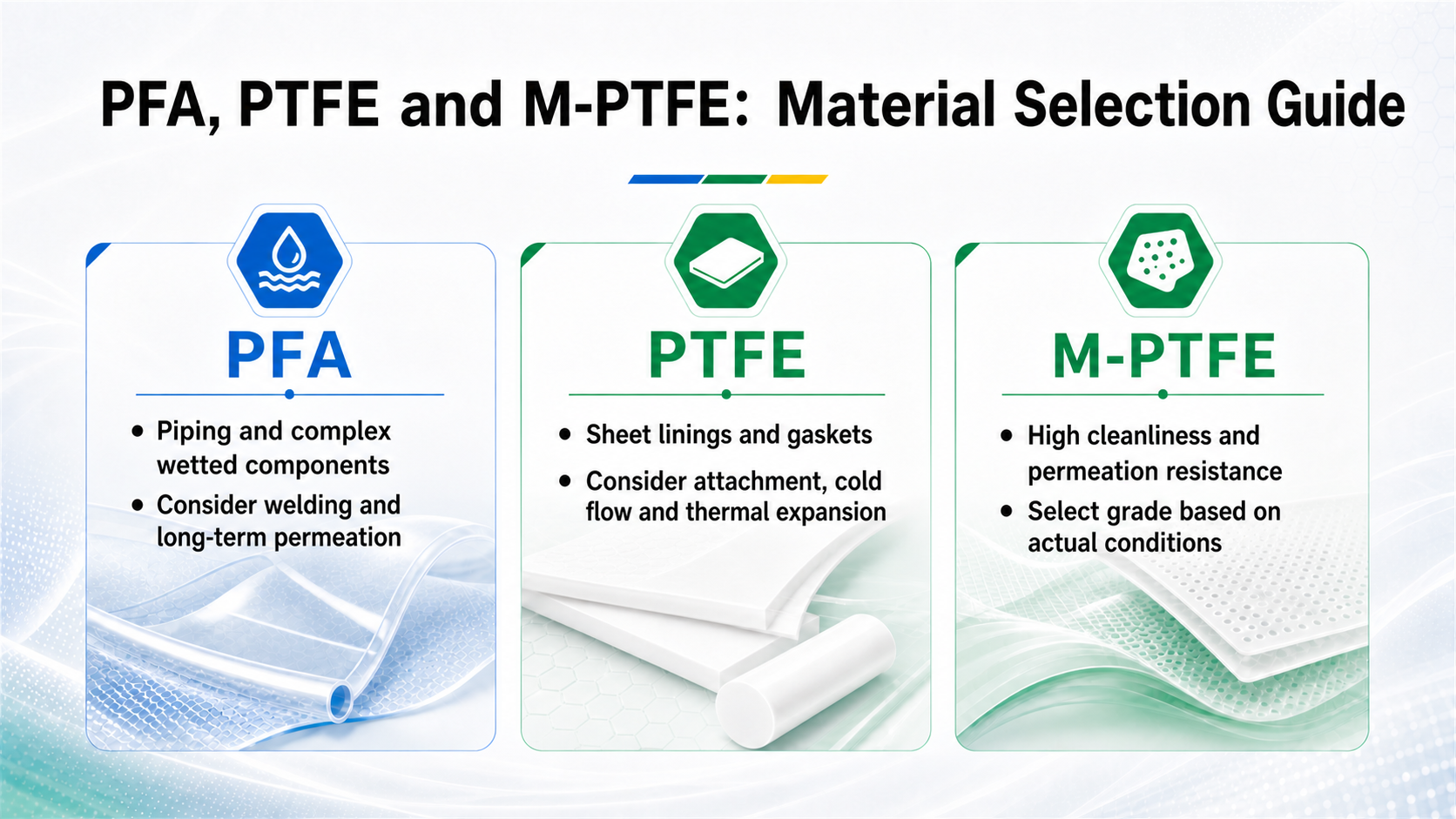
All three materials are fluoropolymers, but they differ in molding methods, welding characteristics, and mechanical properties. When selecting materials, the equipment type and wetted service conditions should be confirmed first before deciding whether to use pipes, sheet linings, components, or composite structures.
PFA Thermoplastic processing and welding can be used, suitable for piping, fittings, valves, heat exchangers and complex wetted parts. However, the diameter, wall thickness, welding method and long-term permeation conditions still need to be confirmed.
PTFE Commonly used for sheet linings, gaskets, and machined parts. When used for sealing large tanks or flanges, considerations must also be given to fixing, cold flow, thermal expansion, and support design.
M-PTFE It is a modified PTFE, which can reduce material porosity and permeability, and improve surface properties and weldability, making it suitable for equipment with stringent cleanliness, permeation-resistance or joint-strength requirements; the actual grade still needs to be selected based on chemicals, temperature and pressure, and equipment size.
When using different materials in the same system, it is also necessary to check the thermal expansion and sealing method of the interface to avoid risks caused by displacement or stress after assembly.
IV. How to Reduce Contamination and Leakage Risks in Processing and Equipment Design?
In semiconductor process leakage improvement, priority should be given to inspecting welds, flanges, gaskets, valves, and interfaces with dissimilar materials, while also addressing joint quality and pipeline stress:
- Wetted Surfaces and Drainage: Reduce bends, gaps, rough areas, and drainage dead zones to minimize chemical and cleaning fluid residue.
- Welds and Corners: Confirm weld continuity, thickness, and corner treatment to avoid weak points at joints.
- Pipeline Support: Maintain appropriate slope and support to prevent pipe weight, valve weight, or thermal displacement from straining equipment interfaces.
- Flanges and Gaskets: Set locking methods based on sealing surfaces, gasket thickness, pressure, and temperature cycles, and allow for disassembly and assembly space.
- Cleaning and Packaging: Control tools, working environment, cleaning, drying, and packaging to prevent contamination of wetted surfaces before delivery.
V. How to Confirm Delivery Quality Through Inspection and Product Traceability?
The tank lining should be inspected for surface, welds, pinholes, and leaks; piping and valves should be inspected for dimensions, connections, and seals; heat exchangers require structural verification of tube bundles, interfaces, pressure, and leakage status. Inspection items, test conditions, and acceptance criteria should be confirmed before manufacturing to avoid discovering discrepancies in judgment standards used by both parties upon delivery.
During the material stage, material, specifications, and batch information should be verified; during the process stage, records of cutting, forming, welding, assembly, cleaning, and inspection should be maintained; during the finished product stage, appearance, dimensions, welds, pinholes, leaks, pressure, or cleanliness-related inspections should be arranged according to the equipment structure. When third-party verification is required, the applicable equipment, test conditions, and report scope should be defined beforehand.
The product traceability should link equipment number, raw material batch, processing records, and test results. In case of anomalies, the process background can be reviewed, and existing interfaces and acceptance criteria can be compared when expanding or replacing equipment.
VI. Eversupp's Material Selection, Processing, and Maintenance Services
Eversupp has accumulated over 20 years of experience in PFA processing, serving more than 300 semiconductor-related industry clients. Its product range covers tank and process-vessel linings, heat exchangers, PFA tubing, lined valves, gaskets, acid supply systems, and customized products.
Services include process condition confirmation, PFA/PTFE/M-PTFE material selection, engineering drawings, fabrication, assembly, on-site engineering, and testing. Product traceability records integrate with raw material intake, process control, and finished product inspection; maintenance items include partial repairs, relining, or replacement of pipes and valves based on equipment condition assessment.
VII. Frequently Asked Questions (FAQ)
-
Q1 Why can corrosion still occur after fluoropolymer lining is installed?Corrosion can occur on the back of the liner, welds, flanges, gaskets, or the metal casing. If the chemical has penetrated the liner, further investigation of material permeation, weld integrity, joint structure, and operating conditions is needed to determine the source of the problem.
-
Q2 Is PFA always more suitable for high-purity processes than PTFE?Not necessarily. Their processing methods and applicable structures differ. PFA can be used to manufacture pipes, fittings, and complex wetted parts through welding; PTFE is commonly used for sheet linings, gaskets, and machined parts. The choice should be made based on the equipment structure, connection method, cleanliness requirements, and testing conditions.
-
Q3 If a joint leak is found, can only the gasket be replaced?You can check the gaskets first, but also confirm whether the flanges are eccentric, whether the sealing surfaces are damaged, whether the bolts are tightened evenly, and whether the weight of the pipeline and thermal displacement are pulling on the joints. Otherwise, leakage may still occur after replacement.
-
Q4 What information is included in the product traceability records?The content can be adjusted according to equipment and project requirements. It usually includes material specifications and batches, processing or welding records, dimensional and visual inspections, and applicable finished product test results, serving as the basis for delivery and subsequent follow-up.
-
Q5 Can existing chemical equipment be re-lined or partially overhauled?An assessment can be conducted first, but the condition of the metal casing, supports, openings, flanges, and existing lining must be confirmed. If the basic structure is still usable, partial repair or re-lining may be a feasible direction; if the damage has spread to the main structure, the scope of replacement needs to be reassessed.