

During transport, electronic-grade chemicals must be protected not only from leakage but also from contamination caused by an unclean or damaged wetted surface. Repeated filling, unloading, road transport, and sea transport expose an ISO TANK to vibration, temperature fluctuations, and operational loads. Over time, the lining, connections, and tank shell may experience varying degrees of wear.
When a lining has aged, the condition of the metal tank shell and primary structure should be assessed before deciding whether the entire tank must be replaced. If the tank remains suitable for continued use, the existing lining can be removed and the tank shell inspected to determine whether relining is feasible.
Key Takeaways
- Loading and unloading, vibration, temperature and pressure changes, and product changeovers are the primary sources of contamination and equipment damage during chemical transport.
- A fluoropolymer lining separates the chemical from the metal tank shell, and the lining’s integrity also affects whether an existing tank is suitable for refurbishment.
- Routine inspections and refurbishment assessments serve different purposes: routine checks identify abnormalities, while a refurbishment assessment determines whether the tank can be safely returned to service for an extended period.
- For international transport, verify the applicable regulations, inspection validity, and supporting documents to avoid disrupting loading, unloading, or cross-border shipment.
1. Why Are Semiconductor Chemicals Vulnerable to Contamination or Equipment Damage During Transport?
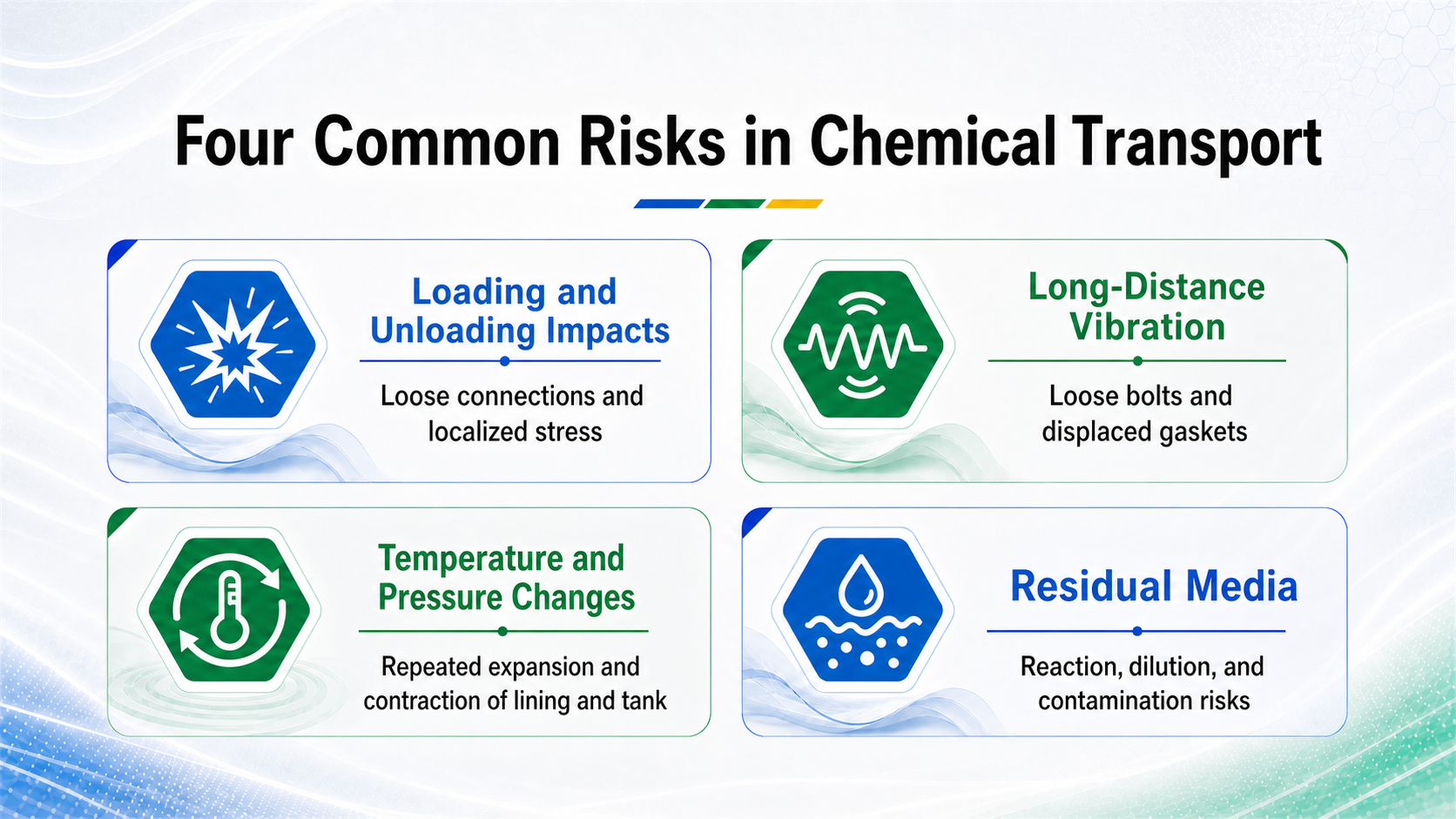
Chemical transport equipment is exposed to loading and unloading impacts, long-distance vibration, temperature differences, and changes in the transported medium. These conditions repeatedly affect wetted surfaces, gaskets, and connections, potentially causing loose fasteners, material expansion and contraction, or contamination from residual liquid.
- Loading and Unloading Impacts:Impacts or vibration during lifting, filling, and unloading may loosen connections or create localized stress concentrations.
- Long-Distance Vibration:Continuous vibration during long-distance transport can loosen bolted joints and displace gaskets.
- Temperature and Pressure Changes:Day–night temperature differences and transitions between sea and road transport can repeatedly expand and contract the lining and tank shell.
- Product Changeovers and Residual Liquid:If residues from the previous load are not completely removed, they may react with the new medium or cause dilution and contamination.
2. How Does an ISO TANK Fluoropolymer Lining Separate Chemicals from the Metal Tank Shell?
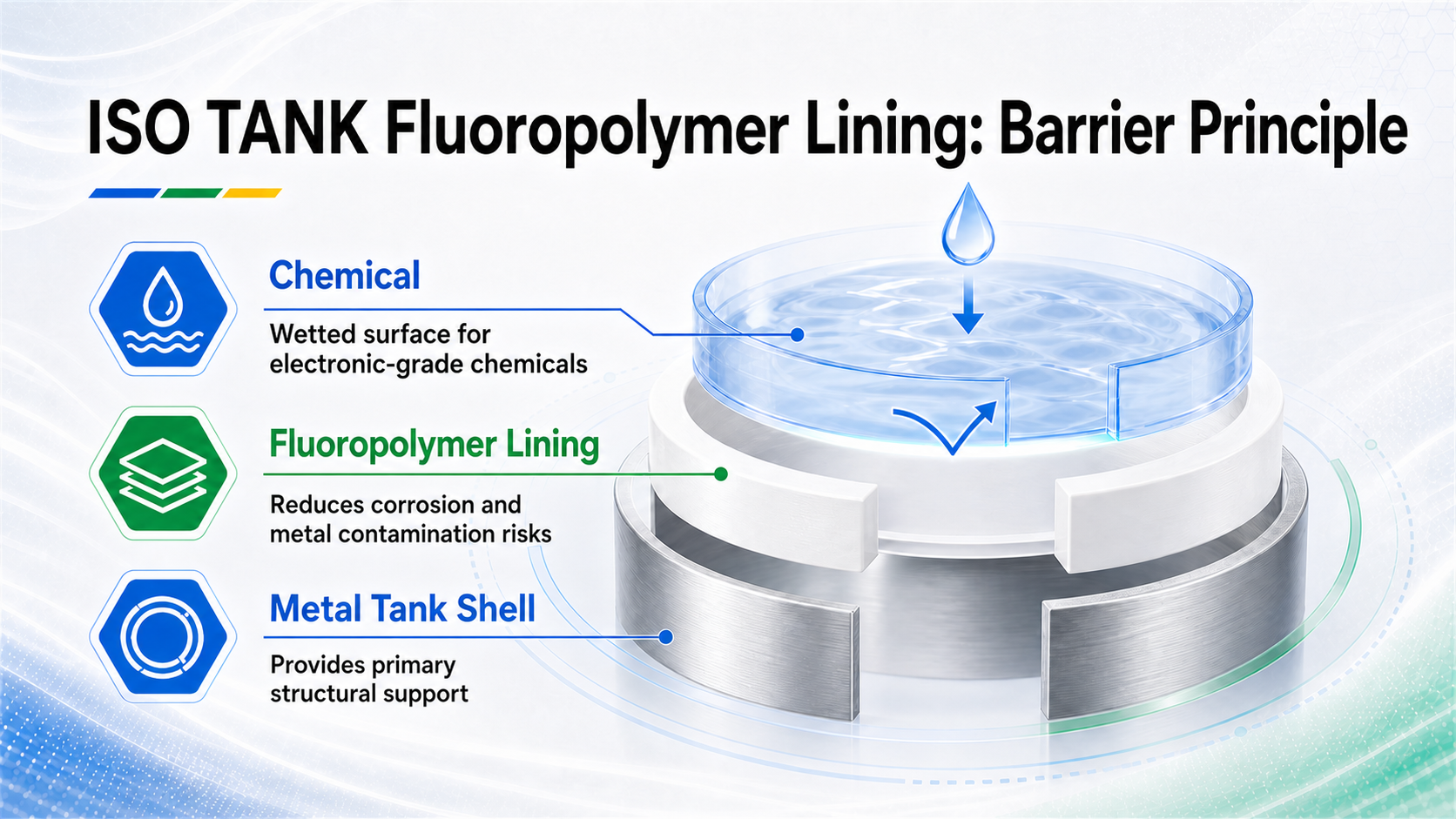
Eversupp ISO TANK systems may use SUS304 or SUS316 tank shells with PFA, PTFE, or M-PTFE linings. The fluoropolymer lining separates the chemical from the metal tank shell, helping reduce the risk of acid or alkali corrosion and metal-ion contamination. For electronic-grade chemicals, surface smoothness, weld seams, and connections also affect residual-liquid and particle control.
PFA can be fusion-welded to form a continuous wetted structure and is suitable for piping, fittings, and complex connections. PTFE is commonly used for sheet linings, while M-PTFE can be applied where greater permeation resistance and joint strength are required. After installation, weld-seam, pinhole, leak, or pressure testing must be completed according to the tank’s intended use.
3. When Should a Chemical Transport Container Be Inspected or Maintained?
Maintenance of chemical transport containers should begin before an obvious leak occurs. Connections, valves, and the lining should be observed after loading, unloading, cleaning, and product changeovers. Arrange an inspection when any of the following conditions occurs:
- Abnormalities occur during loading or unloading, such as an unusually slow flow rate or a pressure reading that differs from normal.
- Before and after changing the transported medium, especially when the concentration or chemical properties differ significantly.
- Visible residual liquid remains after unloading, or odor or discoloration persists after cleaning.
- The lining shows discoloration, blistering, localized clouding, or other visual abnormalities.
- Leak traces or crystallization appear around connections, valves, or the manway.
The inspection scope should cover the manway, valves, gaskets, safety devices, lining, and outer shell. Aging gaskets, flange fastening, valve sealing, or localized weld defects may first be addressed through component or local repairs. If the lining has deteriorated over a large area, the backing shell is corroded, or multiple connections show abnormalities, a full-tank refurbishment assessment is required.
4. How Is an Existing ISO TANK Assessed for Refurbishment, and What Steps Are Involved?
Before refurbishment, assess the extent of corrosion on the metal shell, the existing lining, support structure, opening dimensions, and the condition of sealing surfaces on flanges and fittings.
When the lining is locally damaged but the shell remains intact, a localized repair may be considered. If the lining has deteriorated over a large area but the primary structure remains sound, it may be removed and replaced. If corrosion has penetrated the shell, supports, or opening structures, the viable scope for refurbishment becomes significantly limited.
When the tank shell and frame remain fit for service, refurbishment can retain the existing primary structure, avoid complete tank remanufacture and replacement, extend the equipment’s service life, reduce scrapped material, and limit the scope of renewal.
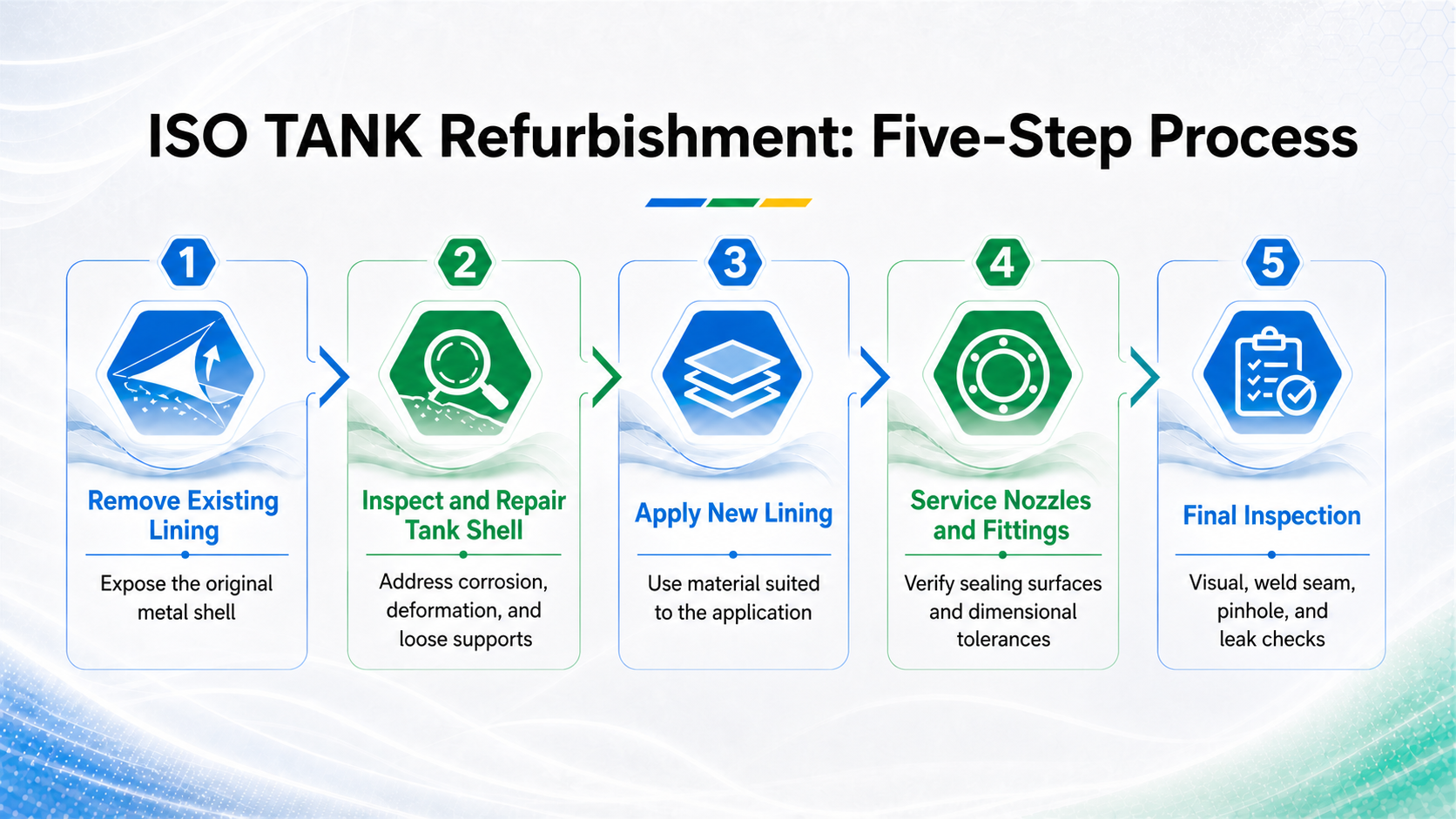
Once the tank has been confirmed as suitable for refurbishment, the general process is as follows:
- Remove the existing lining to expose the original metal shell.
- Inspect and repair the tank structure, addressing corrosion points, deformation, or loose supports.
- Install a new PFA, PTFE, or M-PTFE lining.
- Service connections, flanges, and fittings, and verify sealing surfaces and dimensional tolerances.
- After completion, perform visual, weld-seam, pinhole, and leak inspections in accordance with the applicable acceptance criteria.
5. Which Regulations and Inspections Must Be Verified for International ISO TANK Transport?
The regulations governing international ISO TANK transport vary by cargo classification and transport route. Common requirements include:
| Regulation | Applicable Scenario | Key Items to Verify |
|---|---|---|
| UN Recommendations on the Transport of Dangerous Goods | Basis for dangerous goods transport regulations | Dangerous goods classification, portable tank instructions, markings, and documentation |
| IMDG Code | Dangerous goods transported by sea | Tank, loading, markings, documentation, and transport operations |
| CSC — International Convention for Safe Containers | Containers used in international transport | Structural safety, approval plate, inspection, and maintenance |
| ADR/RID | European road/rail transport | Requirements for inland tanks and dangerous goods transport |
After confirming the applicable regulations, verify the following three categories of information before shipment:
- Tank Approval Information:Verify the nameplate, approval documents, design pressure, permitted substances, and certificate validity.
- Inspection and Equipment Status:Verify periodic inspections and records for pressure resistance, leakage, safety devices, and loading/unloading connections.
- Cargo and Transport Documents:Confirm the chemical classification, tank instructions, markings, loading limits, and emergency information.
UN certification and third-party inspections each have a defined scope and do not cover every chemical or route. Refurbished tanks must also complete the applicable inspection and documentation procedures.
6. What ISO TANK Lining and Refurbishment Services Does Eversupp Provide?
Eversupp’s ISO TANK services cover PFA, PTFE, and M-PTFE linings, lining installation for new tanks, removal and replacement of linings in existing tanks, and the renewal of connections and fittings. Material batches, processing records, and inspection results can be included in the product history for delivery and future maintenance traceability.
Eversupp has experience with classification-society inspections recognized by CCS, BV, and LR for ISO TANK design and manufacturing, and can coordinate third-party verification according to the tank’s intended use. After an existing tank has been relined, pinhole, leak, pressure, or other specified tests are repeated according to the tank specifications.
7. Frequently Asked Questions
-
Q1 What problems most commonly occur during ISO TANK transport?Flanges, gaskets, valves, and loading/unloading connections are the areas most likely to develop problems during transport because they are repeatedly subjected to vibration, fastening, assembly, and disassembly. If leakage is found, first inspect connection loads, sealing surfaces, and fastening conditions, then check whether the lining has been damaged.
-
Q2 Does an existing ISO TANK always need to be replaced in full?Not necessarily. If the metal shell, frame, and supports remain intact, the existing lining can be removed, the tank repaired, and a new lining installed. If corrosion has penetrated the primary structure or openings are significantly deformed, decommissioning or replacement should be evaluated.
-
Q3 How often should the lining be inspected?The manway, valves, connections, and lining appearance may be checked after routine unloading, but these checks do not replace the periodic inspections required by applicable regulations. The actual interval must be confirmed based on the tank’s approval conditions, transported substances, and the requirements of the recognized inspection body.
-
Q4 Is refurbishing an existing tank more cost-effective than purchasing a new one?When the shell and frame remain serviceable, refurbishment avoids complete tank remanufacture and focuses renewal on the lining, connections, and required fittings. If the primary structure is already deformed or corroded, refurbishment should not be forced.
-
Q5 Can an ISO TANK continue to be used after its certificates expire?After certificates expire, inspections should be arranged in accordance with the applicable regulations and recognized body requirements to verify the condition of the tank, fittings, and documents. Loading and transport may resume under the approved conditions only after the required inspections are completed and the certificates are renewed.
Need ISO TANK fluoropolymer lining, existing-tank refurbishment, or chemical transport container maintenance?