

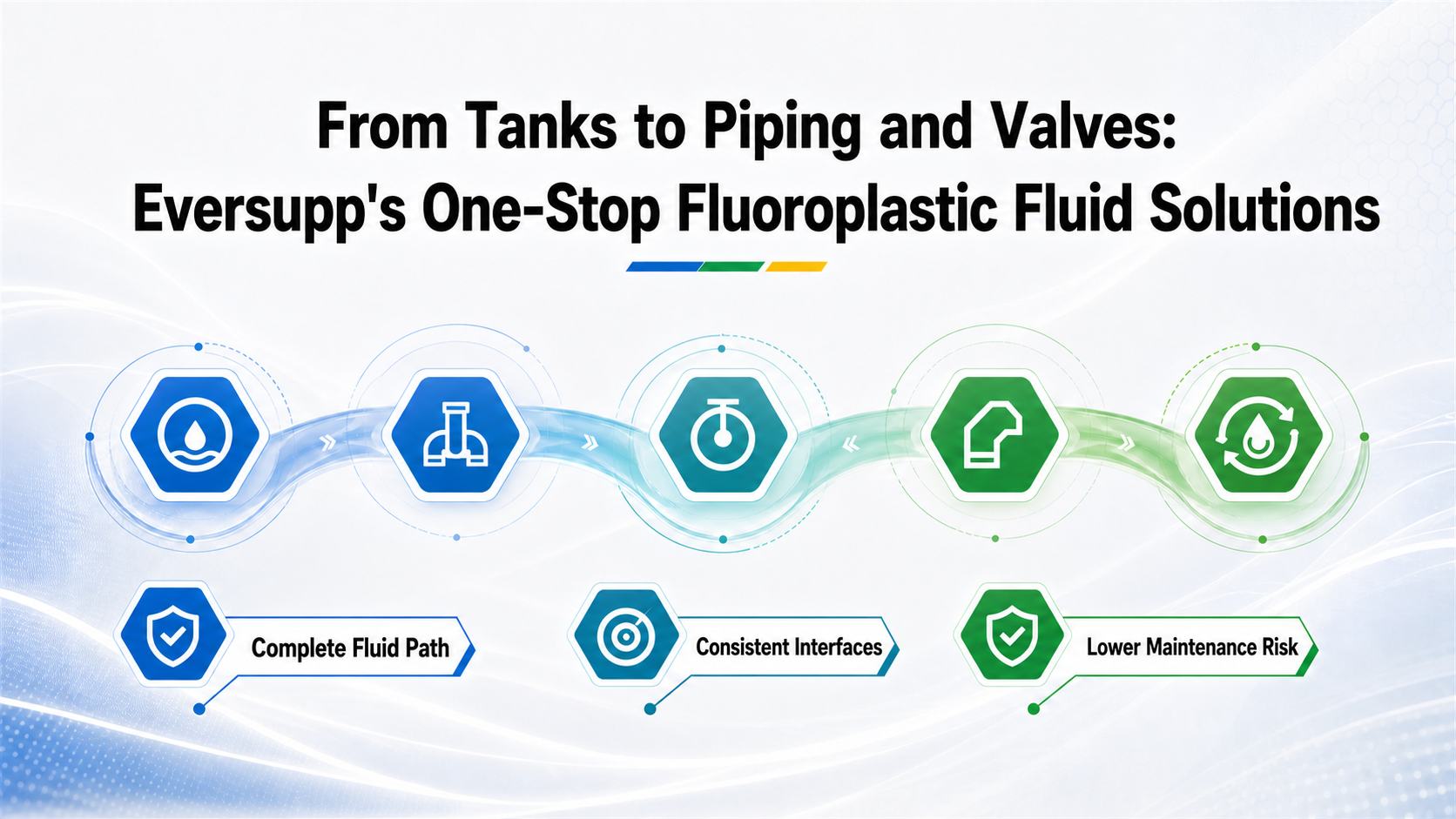
High-purity fluid systems connect tanks, piping, heat exchangers, valves and gaskets. Material incompatibility, inconsistent interfaces or fluid-retention dead legs at any point can increase the risk of leakage, contamination and maintenance issues.
Key Takeaways
- Evaluate a fluid system as a complete flow path instead of purchasing individual components separately.
- Align material selection and connection specifications across tanks, heat exchangers, piping, valves and gaskets.
- Leaks are often associated with welds, flanges, seals and installation conditions rather than failure of the material itself.
- Before custom design begins, define the process fluid, temperature, pressure, flow rate, layout and acceptance criteria.
Table of Contents
1. What is the difference between purchasing individual components and implementing a complete fluid solution?
Individual component procurement typically starts with dimensions, material, temperature resistance and pressure rating—for example, selecting an acid-resistant tank before purchasing piping, valves and gaskets separately. Even if each item meets its own specification, the assembled system may not operate as intended. Flange dimensions, sealing faces, joining methods and differences in thermal expansion can all create interface problems.
A one-stop solution is not simply multiple products on one quotation. It means applying the same process-fluid, temperature, pressure, flow-rate and acceptance requirements across the entire flow path. Tank outlets, heat-exchanger operating conditions and piping or valve connections are aligned during the drawing stage. This system-level coordination is what distinguishes an integrated solution from component purchasing.
Four questions for evaluating the complete flow path:
- Which materials will contact the fluid, and will concentration or temperature change during the process?
- Where are the welds, flanges, threaded joints and removable connections in the system?
- Could liquid remain in the piping during shutdown, cleaning or maintenance?
- Which locations require inspection, sampling, consumable replacement or equipment isolation?
2. How should tanks, heat exchangers, piping and valves work together?
Each item in a fluoroplastic fluid system has a different function, but their design conditions are interdependent. A change to the tank, heat exchanger, piping, valve or gasket specification will usually require adjustments elsewhere in the system.
Tank and Process-Vessel Linings
The wetted material for a tank must be selected according to the process fluid, capacity, liquid-level variation, temperature, pressure and tank structure. PFA or other fluoroplastic linings also require attention to sheet fastening, welds, corners, openings and nozzle locations, with adequate allowance for thermal expansion and contraction. Misalignment between the tank outlet and the piping elevation or drainage direction can also create areas where liquid remains trapped.
PFA Heat Exchangers
Heat-exchanger selection involves more than heat-transfer area. Flow rate, pressure drop, inlet and outlet temperature difference, chemical compatibility and tube-bundle support all affect operation. Repeated temperature changes subject materials and connections to thermal cycling. If piping weight pulls directly on equipment connections, the risk of fatigue and deformation also increases.
PFA Piping and Chemical Lines
Piping selection must consider fluid purity, temperature, pressure, diameter, bend radius and joining method together. The layout should minimize unnecessary turns and dead legs while accounting for support spacing, slope and access for disassembly. If operating conditions may change, long-term permeation and mechanical strength must also be considered—not only short-term corrosion resistance.
Lined Valves and PTFE Gaskets
Valves provide shutoff and flow control. In addition to nominal size and pressure class, selection should account for the valve lining, seat, flow direction and operating frequency. Gaskets must match the flange type, sealing face, bolt-tightening method and process-fluid conditions. Identical materials do not mean that thicknesses and dimensions are interchangeable.
A common interface issue is that different suppliers use different wetted materials, diameters, flange standards, pressure classes or sealing methods without aligning them in advance. Additional adapters or interface modifications may then be required after the equipment arrives on site.
3. How can the risks of connection leaks and material incompatibility be reduced?
When a fluid system leaks, inspect the connections first—including welds, flanges, gaskets, valve stems and dissimilar-material interfaces. The absence of corrosion on the equipment body does not mean the joining and sealing conditions are sound.
Material compatibility cannot be summarized simply as acid and alkali resistance. The same chemical can exhibit different permeation and swelling behavior at different concentrations, temperatures and pressures. Cleaning agents, rinse water and other media introduced during process changeovers must also be evaluated. When PFA, PTFE, metals or elastomers are used in the same system, their thermal expansion, sealing and support methods must be checked together.
Reducing leak risk requires continuity across three stages. Design should standardize interface and sealing specifications; installation should control fusion, assembly and bolt-tightening quality; and acceptance should include weld, pinhole, leak or pressure inspections appropriate to the equipment structure, supported by material and process records.
If leakage is found, first confirm its location and the operating conditions at the time. Then inspect welds, flanges, gaskets and supports. Replacing a component with the same item before identifying the cause can allow the problem to return after restart.
4. What conditions must be confirmed for custom design and on-site work?
A custom fluid system starts with the process fluid, concentration, temperature, pressure, flow rate and acceptance criteria—not with equipment dimensions. Until these inputs are defined, the material, thickness, interfaces and inspection methods cannot be finalized.
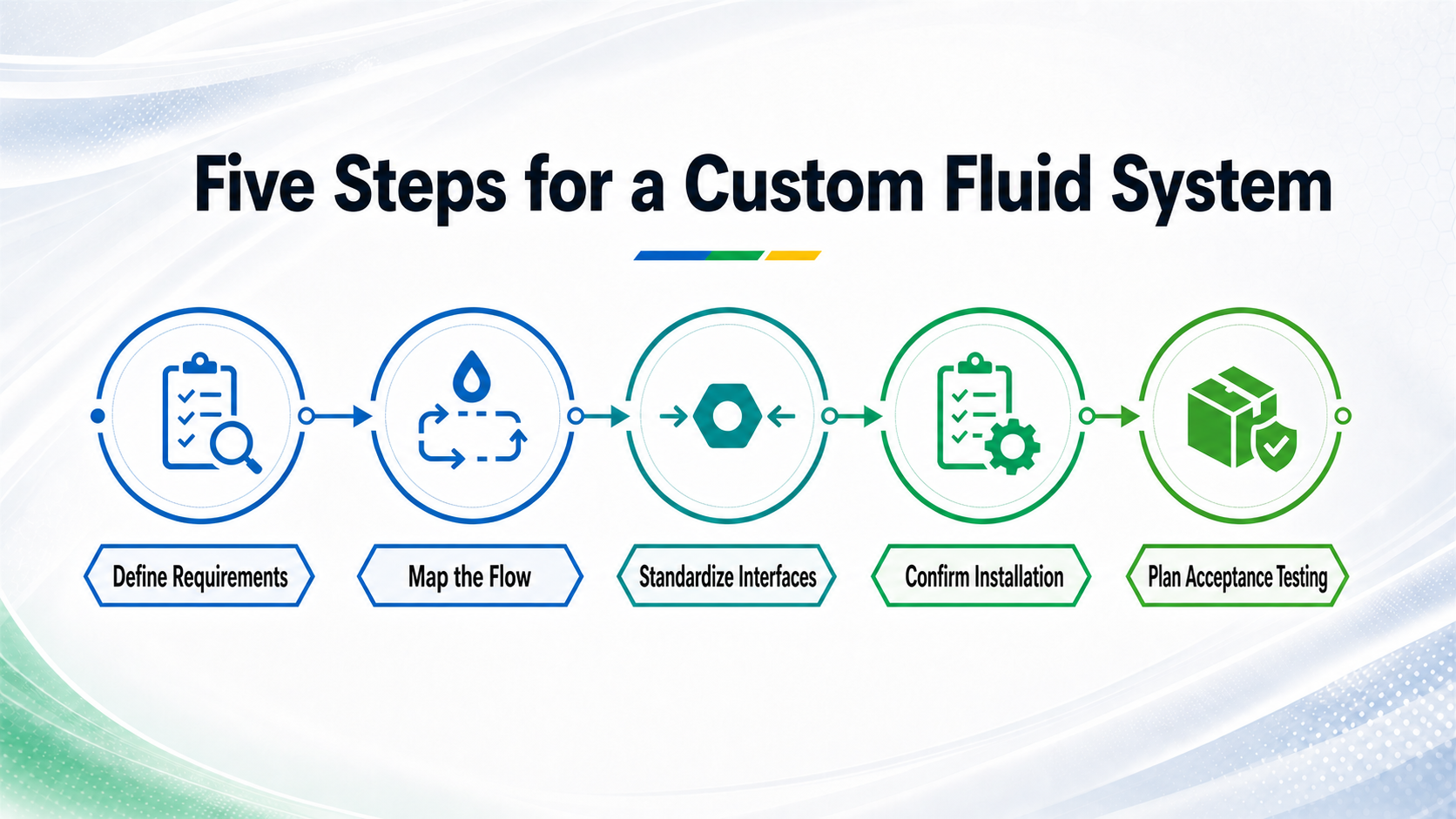
The process from requirements to delivery can be divided into five steps:
- Define the process fluid, concentration, temperature, pressure, flow rate and acceptance criteria.
- Map the flow direction, equipment locations, nozzle orientation and instrumentation layout.
- Standardize wetted materials, diameters, flanges and sealing methods.
- Confirm equipment fabrication, site-entry sequence, installation and maintenance access.
- Plan finished-product inspection, system acceptance and product traceability records.
Eversupp can translate project requirements into an equipment list, interface specifications and a defined scope of work, applying the same criteria from drawings and fabrication through on-site piping and acceptance. The value of integration is not centralized purchasing; it is having a single point of coordination that can trace any mismatch in tanks, heat exchangers, piping or valves back to the same drawings and product records.
5. Which applications are suited to an integrated fluoroplastic fluid solution?
Common applications include semiconductor chemical delivery systems, storage and transfer of chemical raw materials, and wet-process or chemical-supply modules built by equipment manufacturers. These applications involve highly corrosive or high-purity fluids, or fluids that should not contact metal directly.
For new or expanded production lines, align the interfaces among tanks, piping, heat exchangers and valves from the outset. When upgrading existing equipment, begin with sections that have higher rates of corrosion, leakage, retained liquid or maintenance, and then determine the appropriate scope of replacement.
Processes that change frequently require space for future expansion and isolation. Complete material, equipment and inspection records also provide a sound basis for adding branch lines and determining which equipment can remain in service and which connections require revalidation.
6. Eversupp’s Fluoroplastic Integration Capabilities
Eversupp’s product portfolio spans tank linings, heat exchangers, piping, valves, acid-supply systems and custom-fabricated components; heat exchangers can be manufactured in a cleanroom environment. For Eversupp, one-stop service means more than supplying multiple products. The same team oversees both individual components and system integration, reducing specification gaps between suppliers. With more than 20 years of PFA processing experience and over 300 customers in semiconductor-related industries, Eversupp has also extended its capabilities to circular-economy applications. Project experience includes cryolite synthesis systems using waste hydrofluoric acid, TMAH treatment systems and 100 m³ PTFE-lined storage tanks.
7. Frequently Asked Questions
-
Q1 How does PFA piping differ from standard acid- and alkali-resistant piping?The difference is not limited to corrosion resistance. Semiconductor processes also emphasize purity, permeation, joint quality and long-term stability. Standard acid- and alkali-resistant piping may therefore be unsuitable for the process even if it does not corrode.
-
Q2 Must tanks, piping and valves all use the same material?Not necessarily. A system can use PFA, PTFE and metal together, but the compatibility of all wetted materials and the thermal-expansion and sealing methods at dissimilar-material interfaces must be confirmed.
-
Q3 What factors commonly cause connection leaks?Common factors include weld quality, flange misalignment, gasket dimensions, uneven bolt tightening, piping weight, thermal cycling and changes in operating pressure.
-
Q4 What information is required before planning a fluid system?At minimum, provide the process fluid and concentration, temperature, pressure, flow rate or capacity, equipment layout, interface specifications, cleaning method and acceptance requirements.
-
Q5 Can existing equipment be partially upgraded or reintegrated?Yes, but the problem areas must be identified first. If leakage, corrosion or frequent maintenance is limited to specific sections, partial replacement may provide an improvement. If material and interface issues affect the entire system, a system-wide upgrade should be considered.