

氟聚合物加工商之間的關鍵區別在於,他們能否將介質、溫度和壓力要求、設備結構以及潔淨度要求轉化為可加工和可檢驗的規格。即使使用PFA,成型、焊接、支撐和介面處理方面的差異也會導致不同的結果。
本文重點在於:
- 指定 PFA 並不等同於最終選擇;材料厚度、加工方法、焊接配置和設備結構仍需確認。
- 只有在生產前明確介質、溫度、壓力、流速、清潔和驗收條件的製造商,才有能力將使用條件轉換為加工規範。
- 完整的加工計劃除了總價和交貨時間外,還必須涵蓋材料、加工、介面、測試和產品可追溯性記錄。
- 儲槽襯裡還需要對金屬基材、開口、支撐和結構空間進行評估,這與一般零件加工的評估方法有所不同。
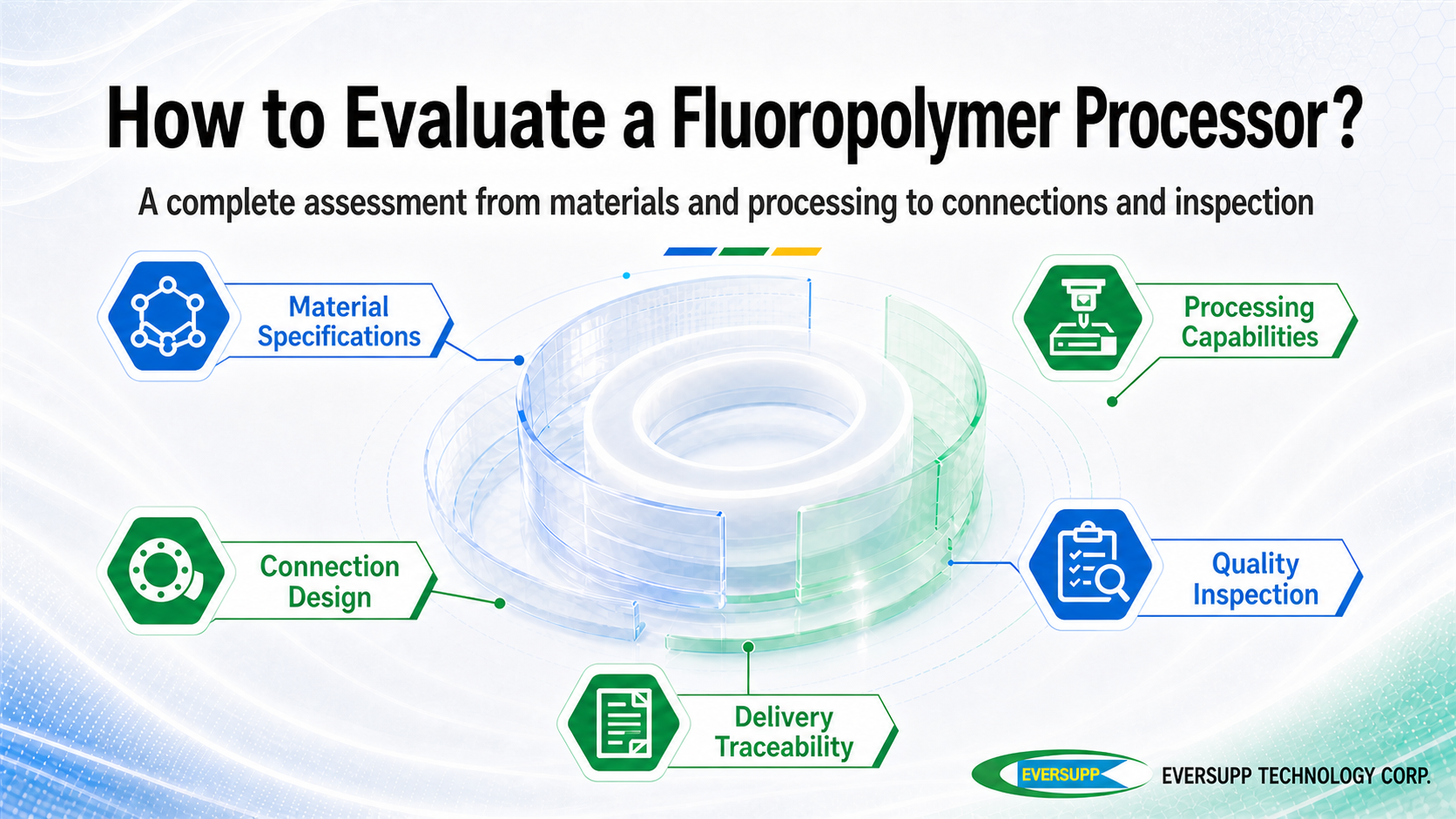
I. Why do equipment performance results differ even when using the same PFA?
PFA can be thermoformed and welded, and is commonly used in chemical piping, fittings, valves, heat exchangers, and tank linings. However, the material name does not fully represent the structure and processing quality of the finished product.
Even with the same PFA lining, differences in sheet thickness, seams, welds, corners, and fixing methods will result in different performance under temperature changes or long-term loads. For piping and components, attention must also be paid to pipe diameter, wall thickness, welding, support, and sealing methods.
If only the PFA material and dimensions are specified without specifying the chemical, concentration, maximum temperature and pressure, flow rate, and cleaning method, the processing end lacks a basis for judging the thickness, structure, and testing conditions.
II. What details best reveal the capabilities of PFA fabricators?
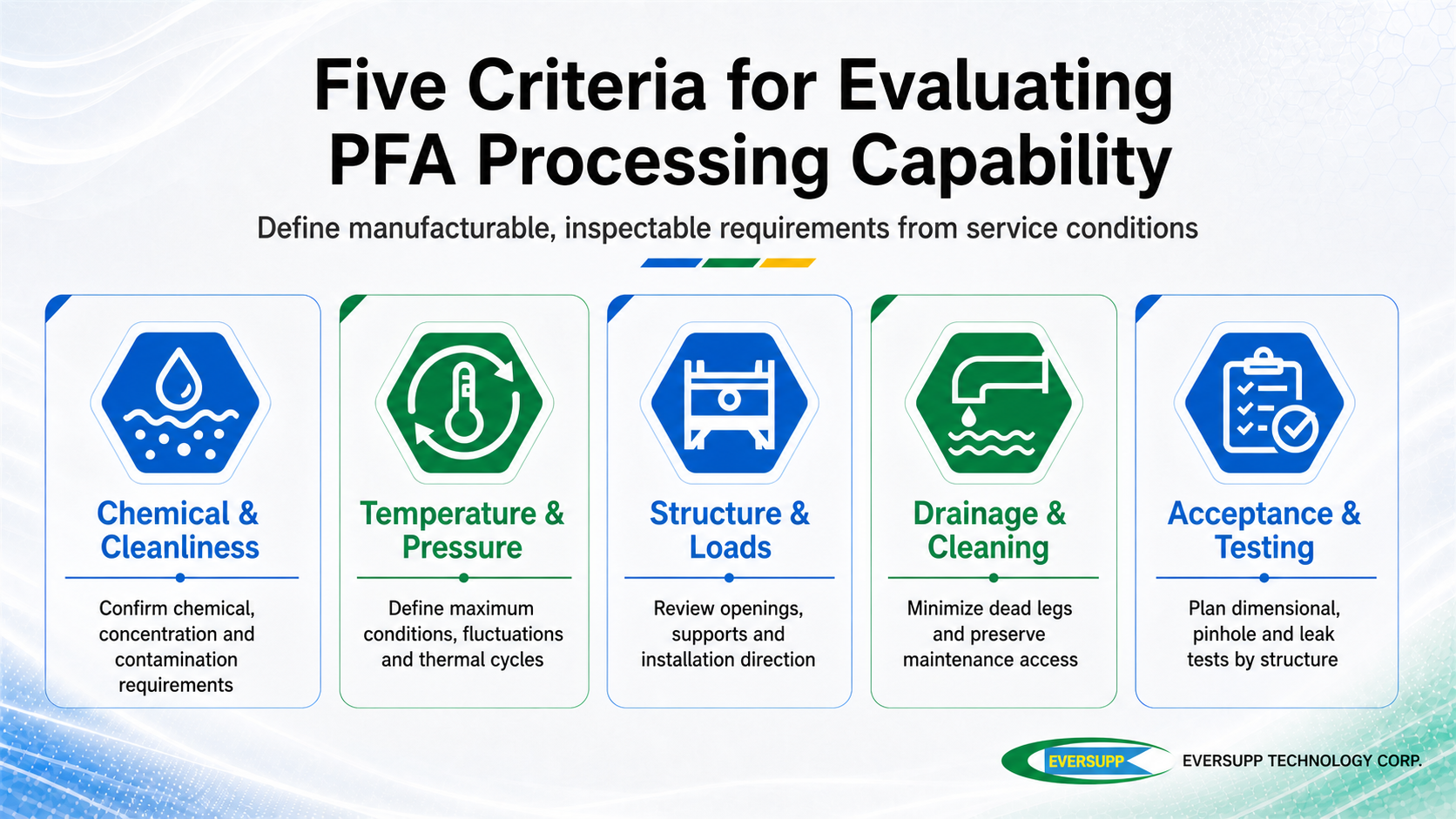
Capable PFA fabricators, in addition to drawings and quantities, will verify actual operating conditions and identify weaknesses in materials, interfaces, and structures before manufacturing:
- Media and Cleanliness Requirements: The type and concentration of chemicals, permissible contamination levels, and media switching methods will affect material handling and wetted surface treatment.
- Temperature, Pressure, and Thermal Cycling: In addition to normal values, start-up and shutdown, pressure fluctuations, and maximum conditions must be understood.
- Equipment Structure and Stress: The tank, openings, supports, piping weight, and installation direction will affect welds and flange connections.
- Drainage, Cleaning, and Disassembly: Drainage dead zones, cleaning methods, disassembly locations, and maintenance space will affect residual liquid control.
- Acceptance Methods: Dimensional, weld, pinhole, leak, or pressure checks should be selected according to the product structure.
If a manufacturer can pinpoint joint, support, or repair issues in the drawings, it indicates their ability to deduce processing specifications from usage conditions. If a quotation only includes the product name, dimensions, and quantity, it becomes difficult to trace discrepancies in specifications later.
3. What Should a Complete Fabrication Proposal Include?
Price and lead time are the easiest figures to compare, but material specifications, fabrication details, connection requirements and the acceptance scope determine whether proposals cover equivalent deliverables:
| Item | A Complete Proposal Should Include | Risk If Omitted |
|---|---|---|
| Materials | Where PFA, PTFE or M-PTFE will be used, including specifications and thicknesses | A material may have the same name but be unsuitable for the actual structure or operating conditions |
| Fabrication | Forming, welding, corners, fastening and required dimensional tolerances | Weak points may develop at welds, corners or thermal-displacement areas |
| Connections | Flanges, gaskets, valves, fittings and methods for joining dissimilar materials | Misalignment, stress or poor sealing may occur during on-site installation |
| Inspection | Visual, dimensional, weld, pinhole, leak or pressure inspection | No consistent acceptance basis is available at delivery |
| Traceability | Material batches, fabrication stages, inspection results and nonconformance handling | Materials and fabrication processes cannot be traced if a problem occurs later |
The quotation should also state whether drawings, accessories, on-site installation, test documents and packaging are included. If the equipment must connect to existing piping, dimensional verification and responsibility for each connection should be defined in advance.
Product traceability records connect material, fabrication and quality-control data, while final inspection confirms dimensions, surface condition and sealing at delivery. Together, they help narrow the investigation scope if an issue occurs.
IV. Why is it necessary to consider the base material and equipment structure when selecting a fluoropolymer lining manufacturer?
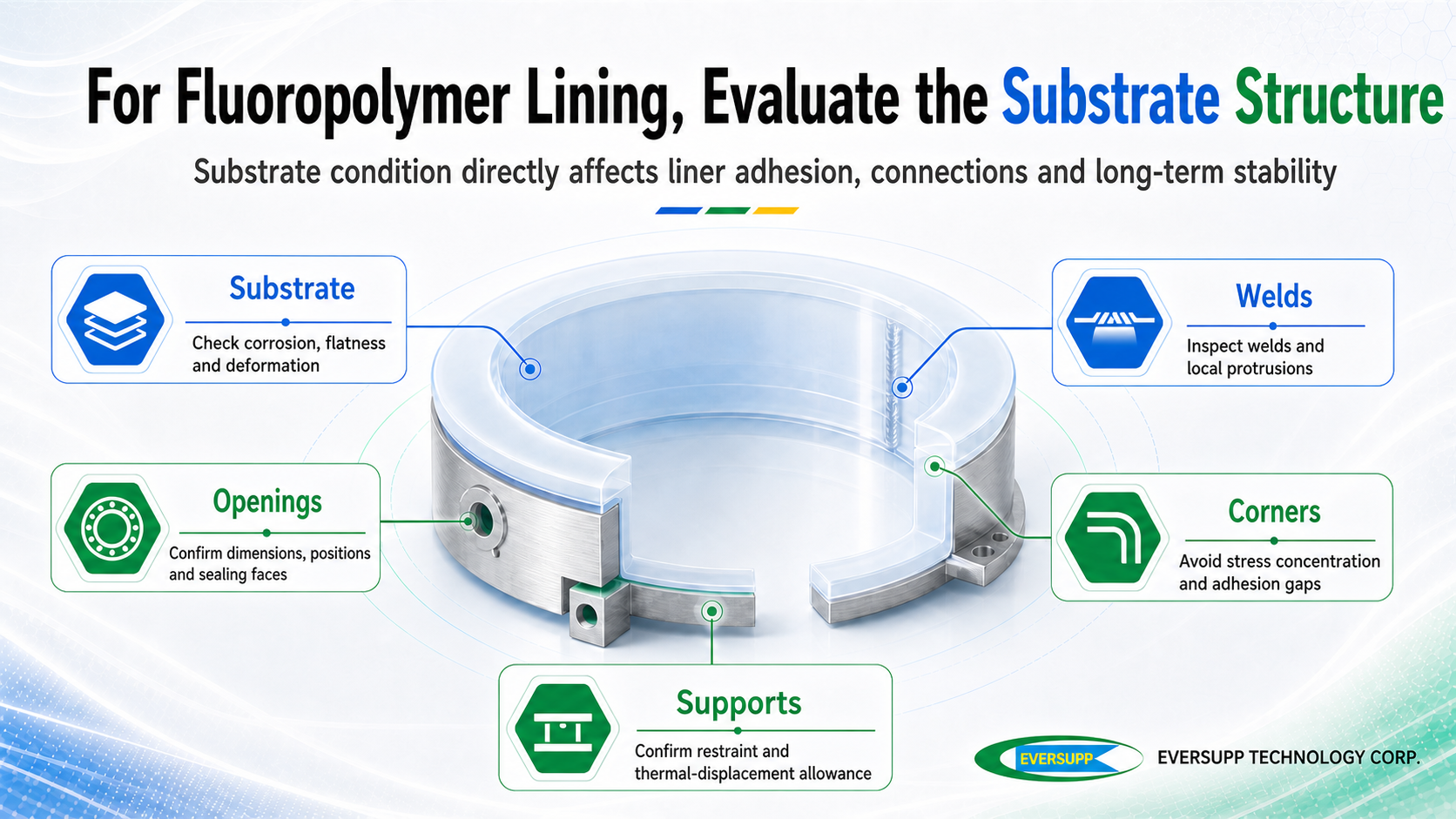
The tank lining is affected by the base material, welds, openings, corners, supports, and thermal expansion. Therefore, the selection of a fluoropolymer lining manufacturer should also consider whether the manufacturer can inspect and handle the base material.
For newly manufactured tanks, the joints of the sheet metal, pipe openings, fixing methods, and construction space should be confirmed first. For existing tanks, corrosion, deformation, welds, and openings should be inspected. Uneven base material, loose supports, or untreated local corrosion will still affect the new lining.
Large tanks also involve sheet metal handling, on-site welding, construction in enclosed spaces, and final inspection. The plan should clearly define the responsibilities for tank finishing, lining, jointing, and inspection.
5. How Do the Required Capabilities Differ Between Individual Parts and a Complete Fluid System?
Gaskets, fittings or components can be fabricated individually when their dimensions, materials and connections are clearly defined. When a project spans tanks, heat exchangers, piping and valves, another capability is required: coordinating and verifying the connections between equipment.
This does not mean every item must be made by one supplier. Projects often involve multiple suppliers; the key is assigning responsibility for interface checks and defining boundaries. If no one coordinates flange sealing surfaces, piping loads and dissimilar-material joints, revisions may be passed back and forth among suppliers.
Projects involving storage, temperature control and chemical supply also require joint review of capacity, heat transfer, flow, instrumentation and on-site installation. A supplier that can support the complete fluid system not only fabricates parts to drawing but also coordinates connections and system-level requirements.
6. How Does Eversupp Support Projects from Component Fabrication to Equipment Integration?
Eversupp offers PFA tank and vessel linings, ISO TANK solutions, PFA heat exchangers, tubing, lined fittings, lined valves, gaskets and custom components. Material and equipment configurations can be reviewed according to the chemical, temperature and pressure, flow rate, drawings and site conditions.
For individual components, the fabrication scope is confirmed according to dimensions, wetted service conditions and installation method. Equipment projects can integrate tanks, heat exchangers, PFA acid supply systems, instrumentation design and on-site piping. Records from incoming materials and fabrication through final inspection are included in product traceability records for delivery and subsequent review.
Eversupp has more than 20 years of PFA fabrication experience and has served over 300 customers. Its ISO TANK and fluoropolymer lining products have experience with CCS, BV and LR recognized inspections, while its central acid supply system quality has also obtained Japanese testing certification.
7. Frequently Asked Questions
-
Q1 Is a material certificate sufficient when selecting a PFA fabricator?No. A material certificate can verify the grade, specification and batch, but it cannot replace fabrication and final-product inspection. Forming, welding, dimensions, connections and applicable leak or pressure tests should also be confirmed before the delivery condition can be evaluated.
-
Q2 Why are process fluids and operating conditions still required when drawings are available?Drawings generally focus on dimensions and structure and may not fully specify chemical concentration, maximum temperature and pressure, thermal cycles, cleaning or cleanliness requirements. These conditions directly affect material thickness, joining methods, supports and acceptance criteria. The same drawing may therefore require different fabrication specifications under different operating conditions.
-
Q3 Which areas should be inspected after PFA welding?Weld continuity, surface condition, corners, nozzles and connections should all be checked. Welds, corners and nozzles are priority inspection areas on PFA equipment because consistent heating and joining conditions are more difficult to maintain there. A normal appearance does not confirm internal integrity; pinhole or leak testing may be specified according to the equipment structure.
-
Q4 How does lining a large tank differ from fabricating standard PFA parts?In addition to material forming and welding, large-tank lining requires assessment of the metal substrate, plate seams, openings, corners, fastening methods and on-site installation. Substrate and support conditions also affect whether the lining can remain stable and accommodate thermal movement.
-
Q5 Which items can be fabricated individually, and which require integrated planning?Gaskets, fittings or parts with clearly defined dimensions, materials and connections can be fabricated individually. If the requirement spans tanks, heat exchangers, piping, valves, instrumentation or electrical controls, the fluid path, connections and responsibility boundaries should be confirmed together.